Basis B1 Review the Best Activity Tracker Despite One Critical Flaw
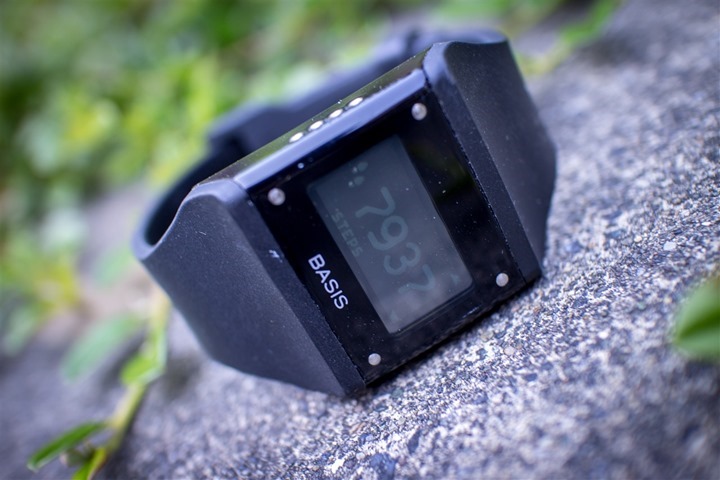
The Basis B1 picket represents the commencement fitness tracker on the market to do 24×7 continuous middle charge per unit monitoring (all without a heart rate strap), in add-on to all of the usual metrics like a footstep-counter and sleep. Adding to that, they besides measure skin temperature and perspiration. But does the long-awaited watch that hit the market a few months ago actually live upward to expectations? Or is information technology but a bunch of geek-like information with no context? Well, I dug in to discover out.
I've been using the device for months now, wearing it 24-hour interval and night. Because I want to be transparent about my reviews, once my evaluation period with the Ground unit of measurement has elapsed, I ship it back to Basis in San Francisco. Unproblematic as that. Sorta like hiking in wilderness trails – leave merely footprints.
Lastly, at the terminate of the mean solar day proceed in heed I'm just like any other regular triathlete out there. I write these reviews because I'yard inherently a curious person with a technology background (my twenty-four hour period job), and thus I endeavour and be as complete as I can. But, if I've missed something or if you spot something that doesn't quite jive – just let me know and I'll be happy to go it all sorted out. Too, because the technology world constantly changes, I endeavor and go back and update these reviews as new features and functionality are added – or if bugs are fixed.
Unboxing:
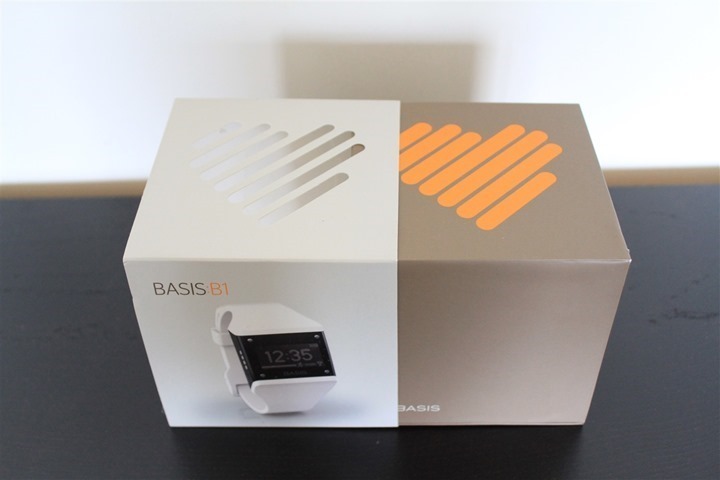
First up on our journey to enlightenment is getting the thing unboxed. Thus, the box:
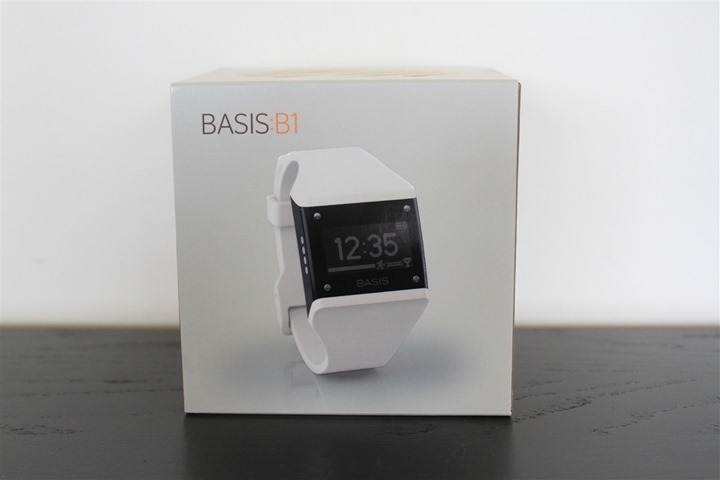
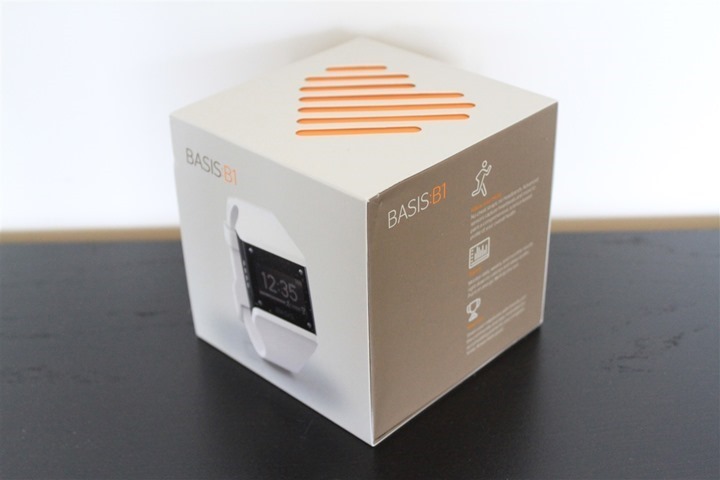
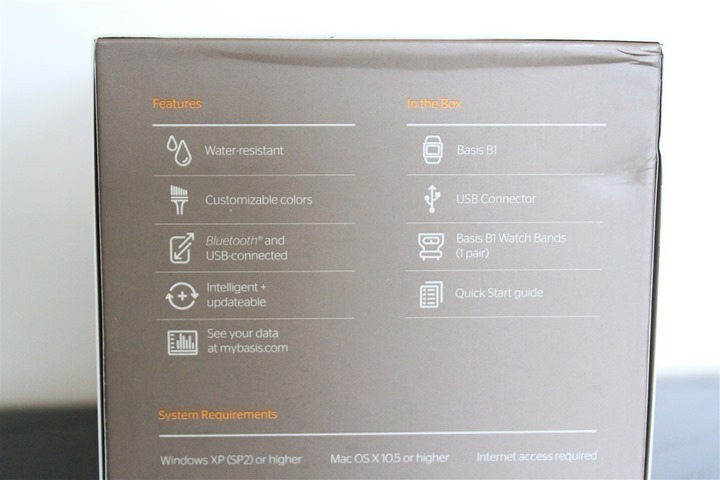
I thought it was slightly interesting that the box noted Bluetooth connectivity about iii months earlier it actually had whatever Bluetooth apps bachelor…
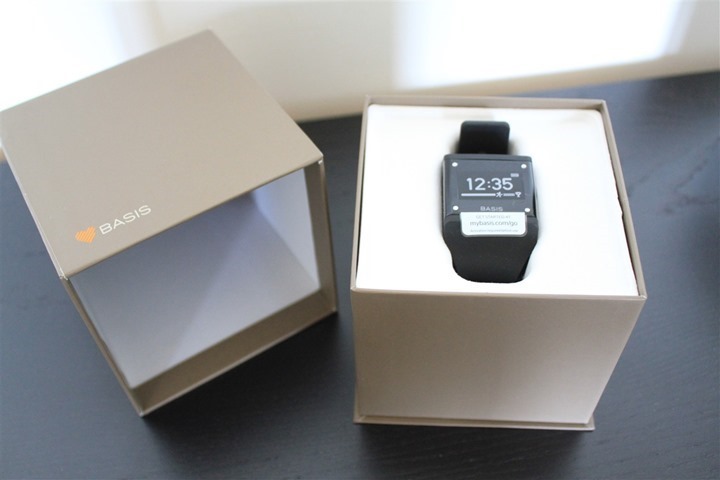
In that location'southward actually an inner box inside the shell of the outer box. You'll desire to pull the inner from the outer.
Then at that place'south yet some other box inside the inner box. Information technology'due south like one of those piffling Russian wooden dolls. Inside that, you'll finally notice the lookout man looking upwardly at you.
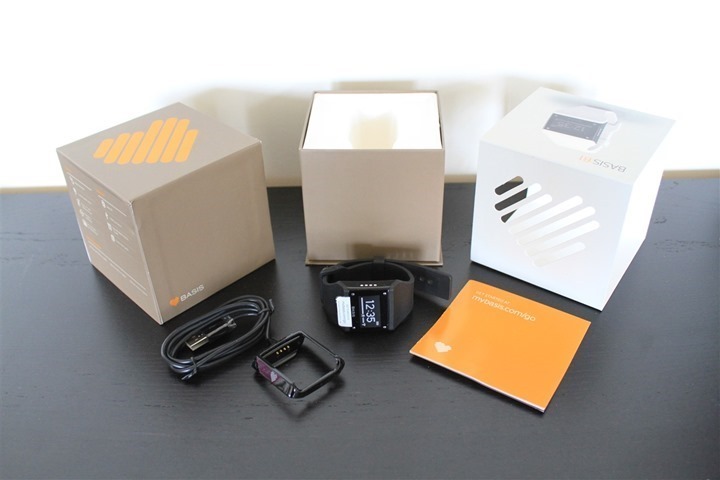
Below the watch is the charging cable and a tiny lilliputian newspaper manual. Here's what the whole kit looks like once unboxed:
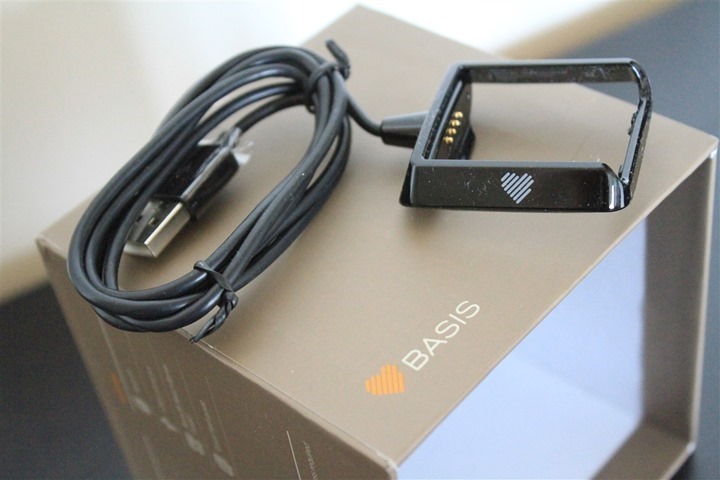
Taking a slightly more than detailed look at the components, here's the charging cable. This USB cable is for both charging as well as syncing of your fitness data via the Basis Sync agent (which is software you install on your computer).
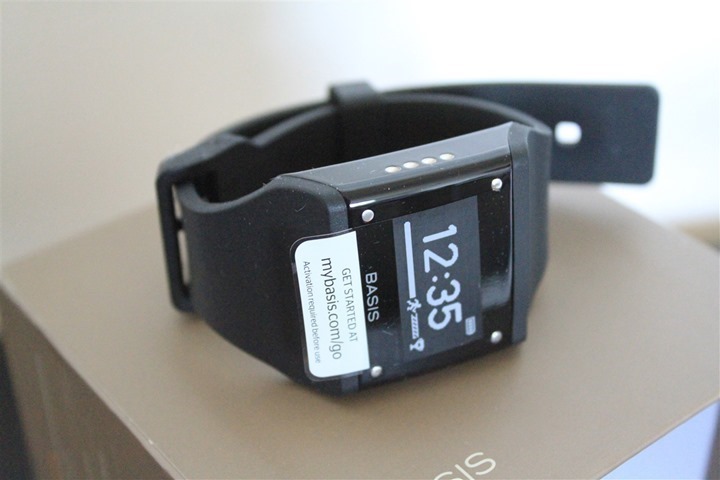
Then we've got the lookout man itself. In the picture beneath you can see the four trivial charging contact points on the border of the watch. This is where the cradle snaps in and connects.
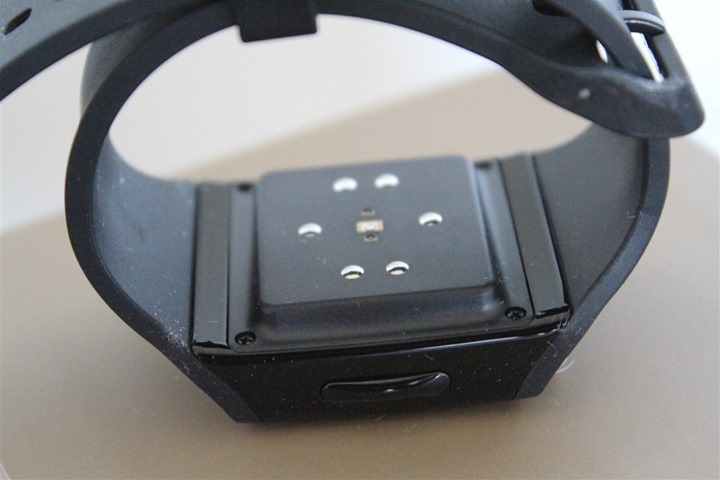
Flipping it over you'll run across the sensors on the underside. This is obviously the side that touches your pare, allowing it to gather heart rate, skin temperature, and pare perspiration metrics.
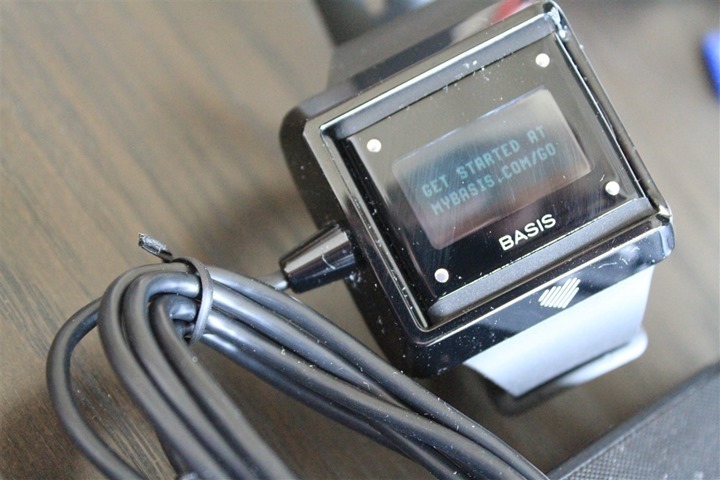
Once y'all've pulled off the little plastic protector and added some USB power (thus turning it on), it'll prompt you to go out to the Ground site and grab the software to get the unit cooking.
With everything unboxed, let's swoop into how it compares to other units in the field from a physical standpoint.
Size Comparisons:
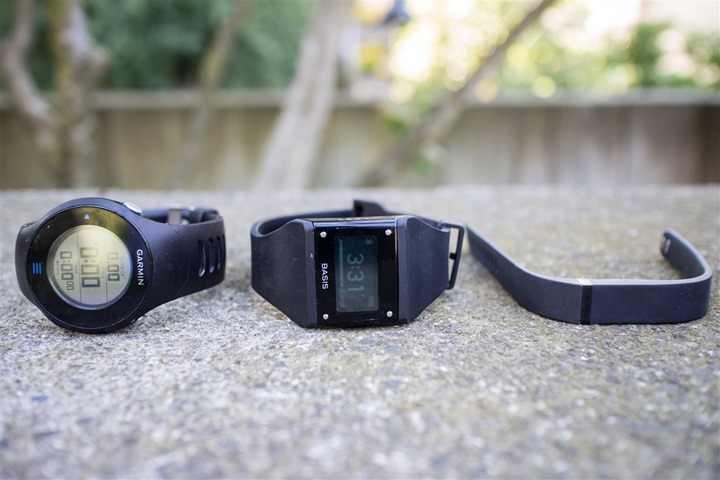
The Ground watch is pretty normal sized when it comes to watches. It'south neither big, nor small-scale – it just sorta sits in the middle size-wise. Here's a look at how it compares to a running-specific picket, the Garmin FR610:
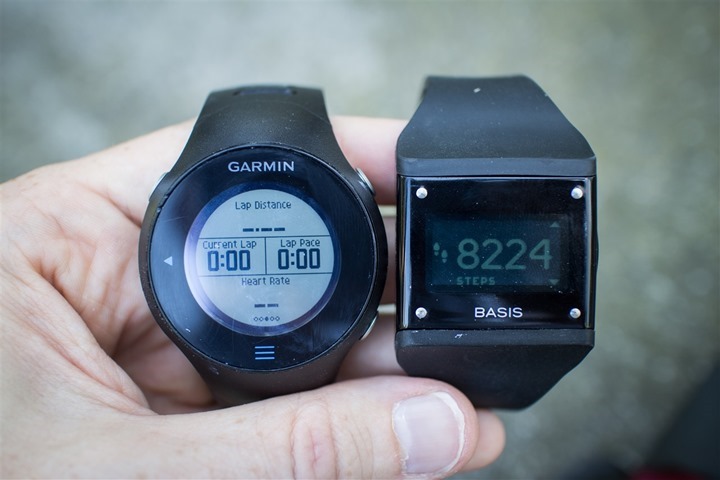
Every bit yous can see, the elevation of the watch is a bit college than most other units on the marketplace, thus making it look a scrap more bulky than it really is.
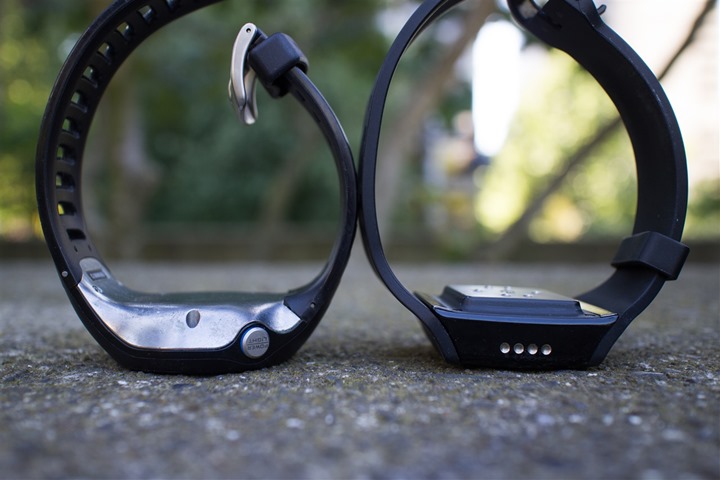
I suspect that much of this vertical bulk comes from the platform backside the varying sensors that are contained within the unit of measurement – such every bit the optical and skin temperature sensors.
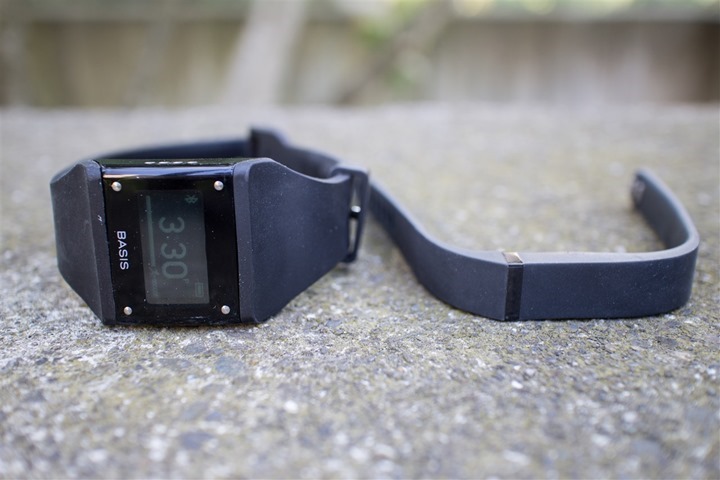
When y'all compare it to other fettle trackers on the market you have to take into account that this is in a very different grade cistron than others. Most other units autumn into one of 2 camps: Either waist band worn, or wrist worn. But for the wrist-worn ones, all of the others on the marketplace are focused on looking more than similar a bracelet than a watch.
Thus size-wise, the Basis is definitely amongst the biggest on the market since it includes a full watch face up, versus just having no brandish, or minimal time display. At the same time, the others on the market besides don't have the optical or pare sensors, which require a larger/flatter base to function. You can run into the difference below between the Basis wrist watch and the Fitbit Flex wrist bracelet.
And finally, comparing to waist worn units (such as the Fitbit Zip) is like comparison watermelons to strawberries. Nonetheless, to put things into perspective, here ya go:
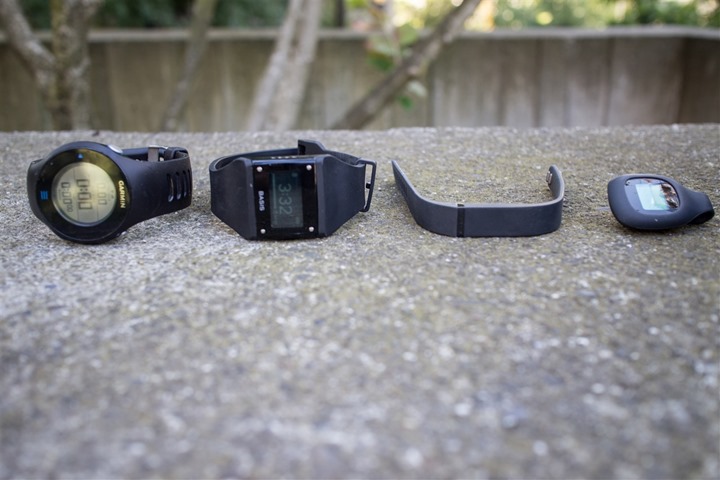
Obviously the activity tracker location is going to come down to personal preference. Do y'all prefer wrist or waist? I detect that wrist tends to be amend from a motivation standpoint (since it's always at that place and visible). Additionally, wrist tends to be easier to remember if you switch pants. On the flipside, the waist units tend to take a much longer bombardment life, and thus the impact on neglecting to charge information technology oftentimes can exist negated. Again, largely a personal preference particular. Besides note that when I say 'waist' I'g largely referring to all clip-on units, which can exist worn on your waist, pockets, and for women usually clipped on your bra.
General Utilize:
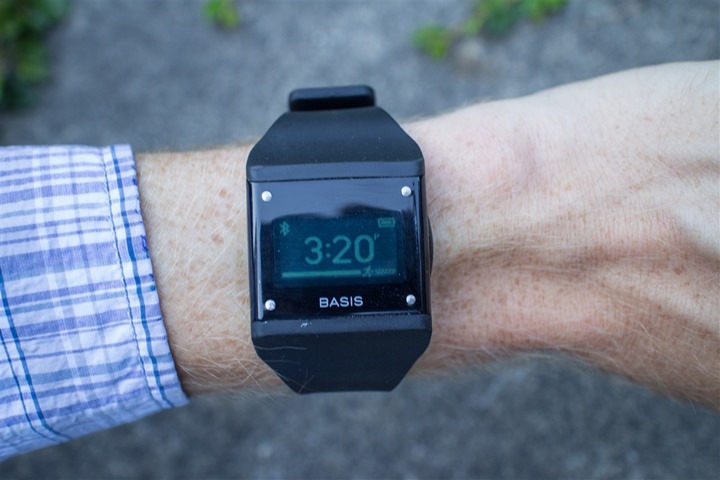
The very beginning question most people inquire is how tight you have to wear the watch. In my use, I've found that I haven't had to wear it whatever tighter than I would wear whatsoever other watch. In full general, information technology doesn't leave any marks on my arm post-use.
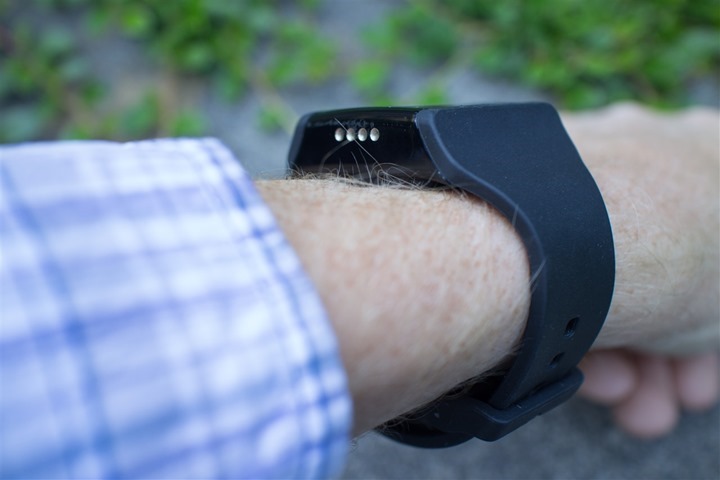
Once you lot've got the unit on your wrist, you'll exist ready to roll. The unit itself actually has very little that yous can practice to information technology, or display from information technology. There are 4 small button on the top – each beingness those little silver dots you see. The upper left push button turns on the backlight. The lower left push swaps betwixt appointment and time:
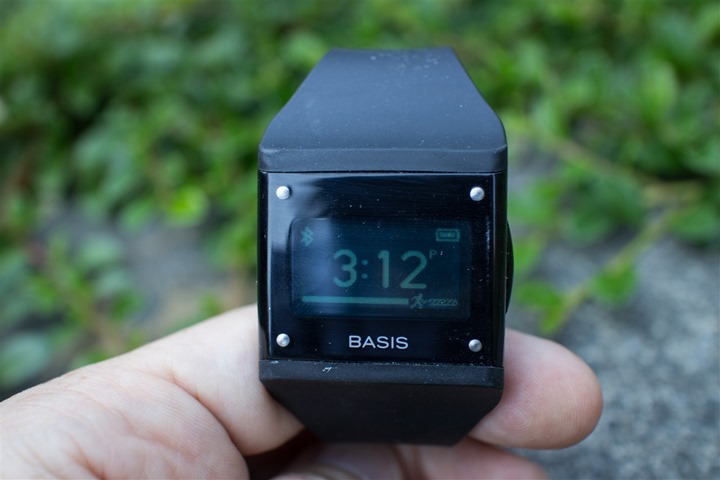
And the ii right buttons iterate between the three data fields that you can brandish: Calories, Steps, and Heart Rate.
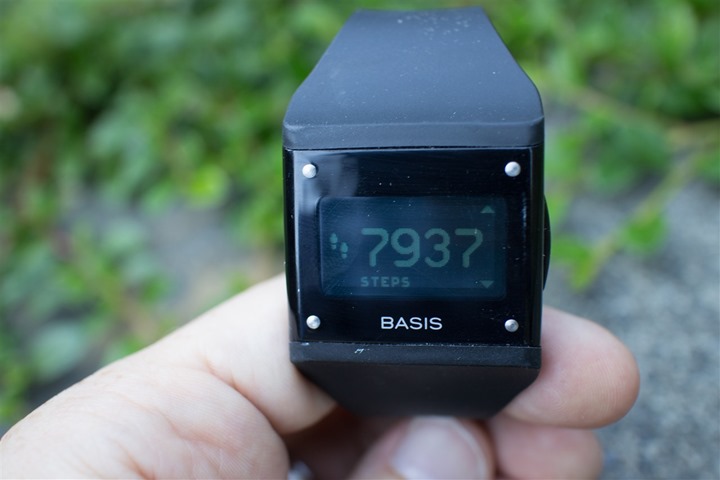
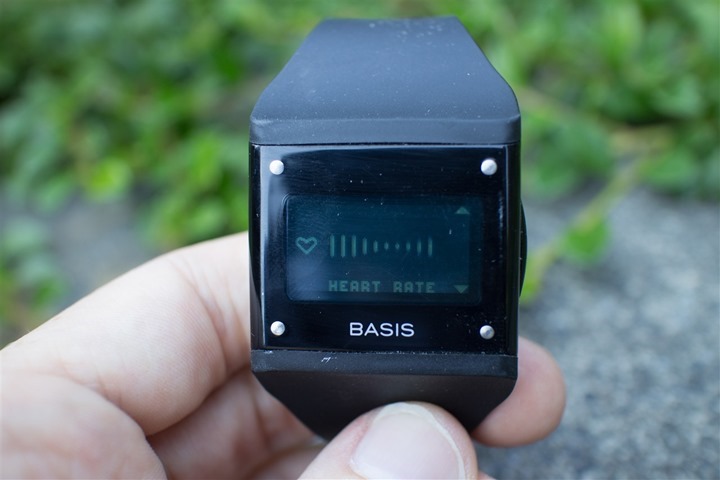
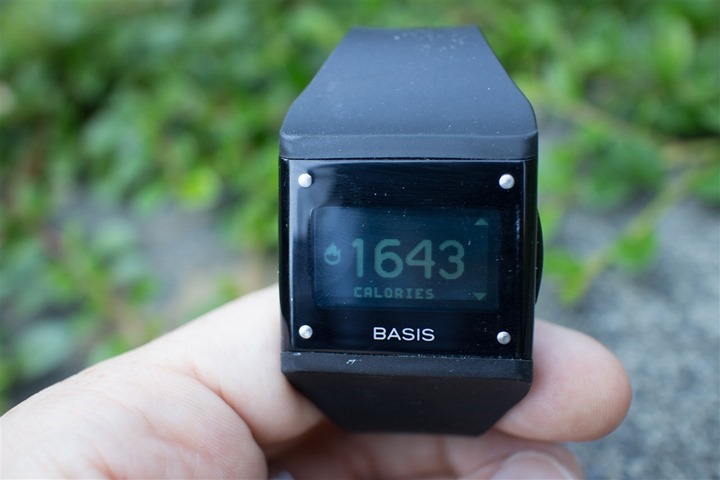
From a push standpoint, lastly, the side push triggers the Sync menu:
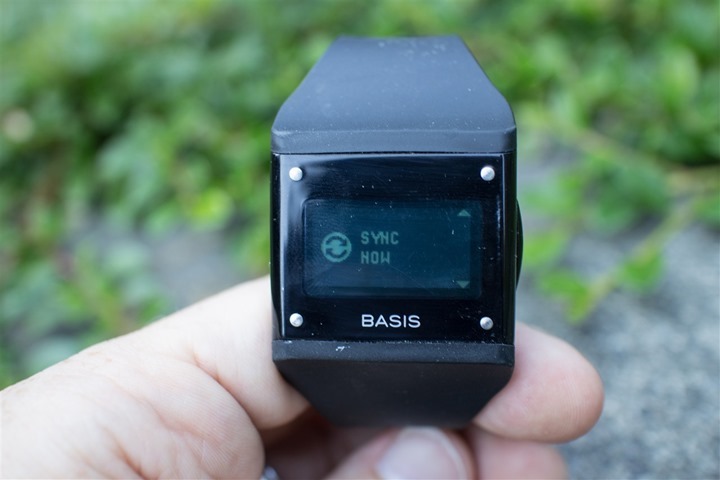
Just I'll comprehend the Bluetooth Sync piece a fleck after in the phone synchronization sections.
Finally, the band does really break autonomously. The thought behind that being to let y'all to swap out ring colors. The problem here is that I've besides had it break apart for no particular reason, causing the sentry to fall to the floor. For instance, I somehow got it caught on my freezer door one day while opening information technology and it broke apart. Go figure.
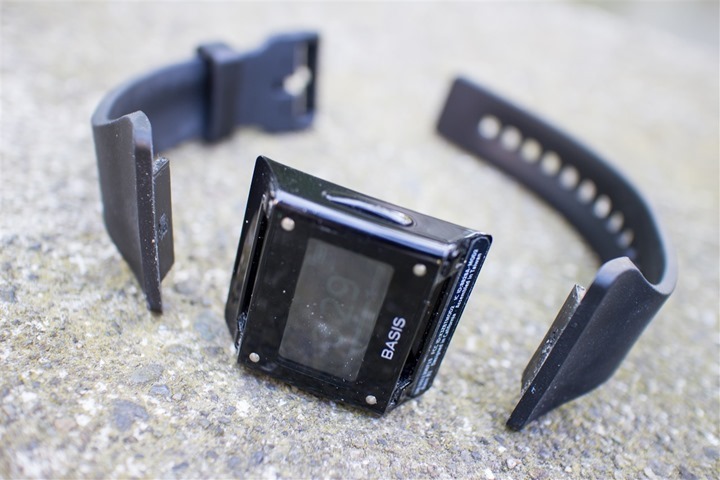
Additionally, this little area between the sentinel and the bands seems to exist a haven for dead skin, grit, and god knows what else. It wasn't pretty when I opened information technology upwardly recently:
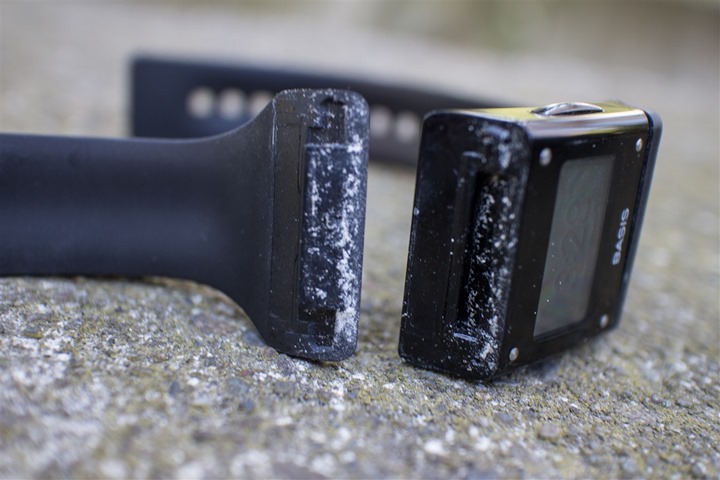
Nonetheless, the band falling apart has just happened to me a few times, and each time the unit came away from the feel seemingly functional.
Pace Counter:
Like nigh activity trackers on the market, the B1 includes an internal accelerometer that allows it to measure steps. This is one of 3 metrics (Steps/Center Rate/Calories) that are available to announced on your wrist with the tap of a button.
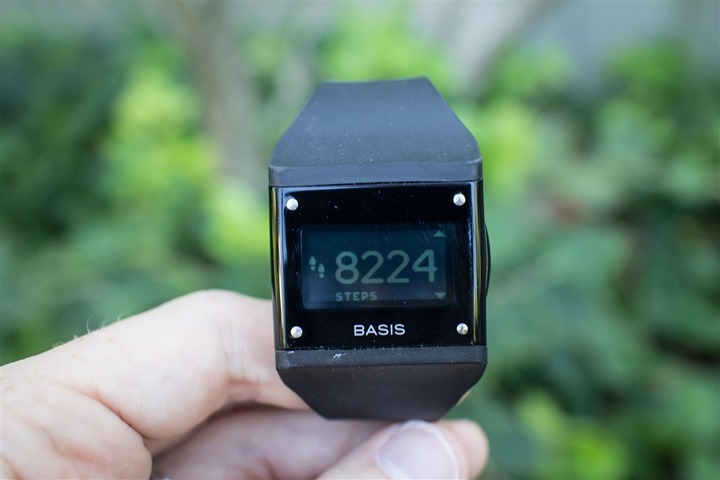
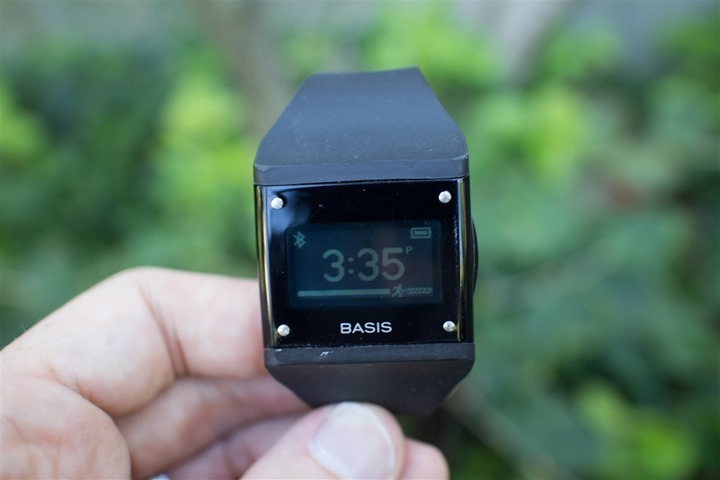
Equally you walk around over the course of the day that will increment, in turn causing your progress bar towards ten,000 steps to increase:
Afterward, this is available on the site for deeper analysis:
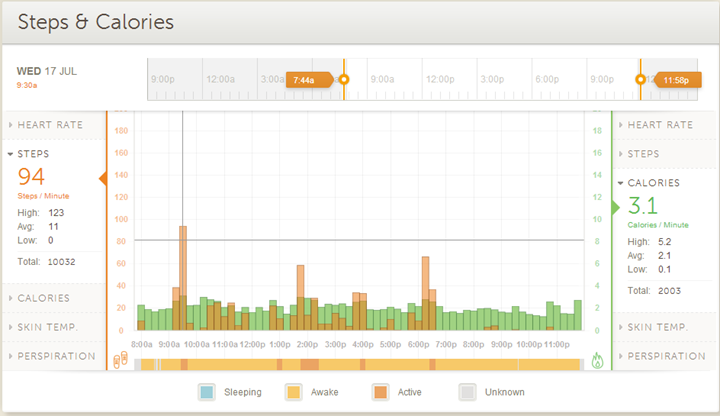
On the left you'll come across the high steps per minute I made, likewise as the average, low and totals for the time period. In this case, I've constrained my time period to be the time I was awake that mean solar day.
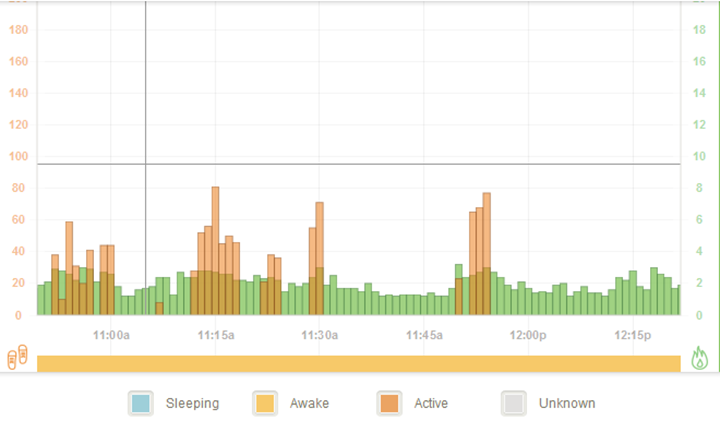
If I zoom in further, y'all'll come across the scale alter a bit from larger time chunks (15-30 minutes) to much smaller chunks (i minute):
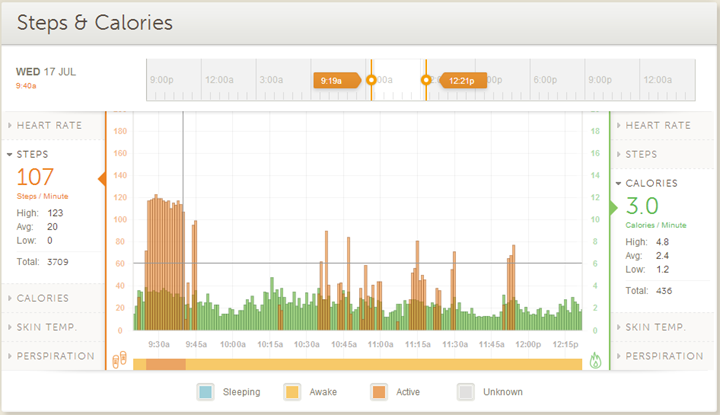
In talking with Footing, I confirmed that while the data is recorded at levels sub-1-minute, it is but displayed at the 1-minute interval, as you can come across below.
Step Counter Accuracy:
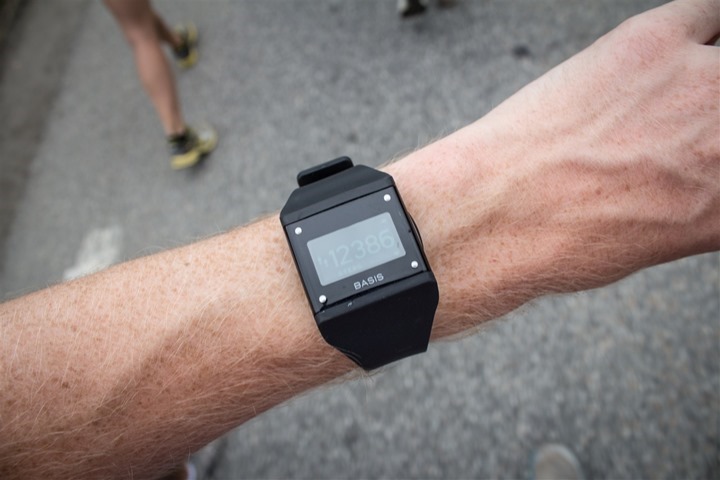
Anytime a device records a value I similar to validate that the value is actually accurate. In the case of altitude related values, that tin can usually be accomplished by measuring a preset class and validating the unit confronting that – or confronting other 'known proficient' units. With the case of the step counter, there'south 2 basic types of tests. Commencement is an outright footstep counter against a simple known stride value. In this first pace I just simply walked 100 steps then checked what the value was of each unit.
For my 'comparison tests', I used 2 other devices, both waist-worn units. The first was the FitBit cypher, and the second the Withings Pulse.
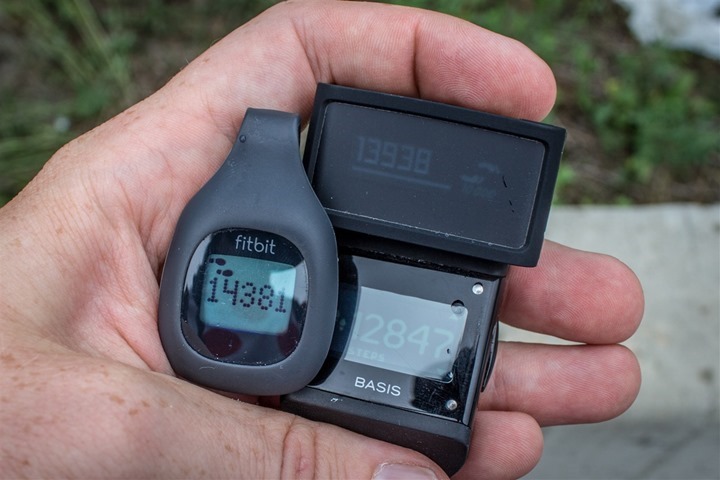
Looking at the 100-step exam, here's how they each fared:
Exam #1 – With Basis on my right wrist:
Basis B1: 99 steps
Fitbit Zip: 101 steps
Withings Pulse: 100 stepsTest #two – With Basis on my left wrist:
Ground B1: 98 steps
Fitbit Zip: 101 steps
Withings Pulse: 102 steps
Not to shabby really, pretty darn accurate given everything. Both tests were but a walk across a parking lot.
Next up was a series of tests over the course of near a calendar week, comparing data confronting the iii devices. In these cases I did not article of clothing the device during whatsoever of my scheduled runs, only instead focused purely on "the other 23 hours".
Start three days, with the Footing on my left wrist:
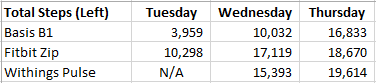
Next 6 days, with the Basis on my correct wrist:

(Annotation: I accept no idea why the Fitbit Zip seems to have such oddly high numbers for Tuesday)
As you tin clearly see, the unit appears far more than 'accurate' on my correct wrist than left wrist. This is somewhat problematic for me in that I adopt wearing watches on my left wrist (I'm right-handed). In 5 out of the 7 days as noted above, I had friends that were with u.s. nigh 24×vii, and interestingly, they had more traditional step–counters on them. While our steps were apparently non identical, I did find that the Basis unit was in the ballpark of their units on the days when I wore it on my right wrist, merely like my ain data – information technology was skewed significantly off when on my left wrist. The one exception was Friday, where you can see the Ground unit was substantially lower. Very odd, with no logical explanation.
Thus I'd encourage you to do some elementary tests (like the 100-step or similar examination) to see which wrist gives you the most accuracy. Interestingly, when looking back at my Nike+ Fuelband review, doing the 100-pace tests I saw much greater variation than I did with whatever of the units here.
Heart Rate (Optical):
Maybe the most interesting function of the Basis B1 scout is its ability to mensurate heart rate optically. This means that you don't wear a traditional eye rate strap and instead the sensors on the inside of the wrist strap will measure out heart rate for you. This is accomplished by measuring changes in blood menstruum within your capillaries. In doing and so it's measuring the reflection of light emitted by the green sensor. Past doing that they tin can discern heart rate.
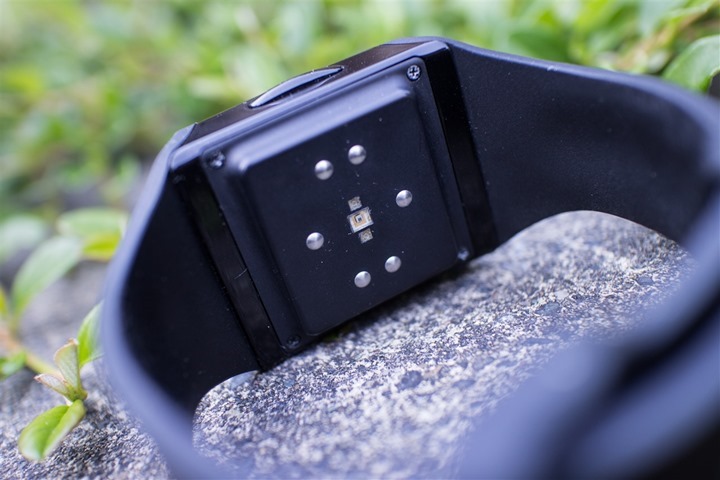
This method works well in most conditions the unit is targeted at (the 23 hours of the day yous're not working out), but at that place can exist some hiccups. In general, erratic movement tends to be an issue, producing potentially erroneous results. I haven't seen annihilation substantial, but certainly occasionally questionable. For example, it'southward not going to spit out at 180 BPM value only because you swing your hand while sitting at your desk. But it may be slightly higher than information technology should exist.
One time information technology contacts your skin, the unit volition trigger its green optical sensor lights, which you lot can see coming out the heart of the watch:
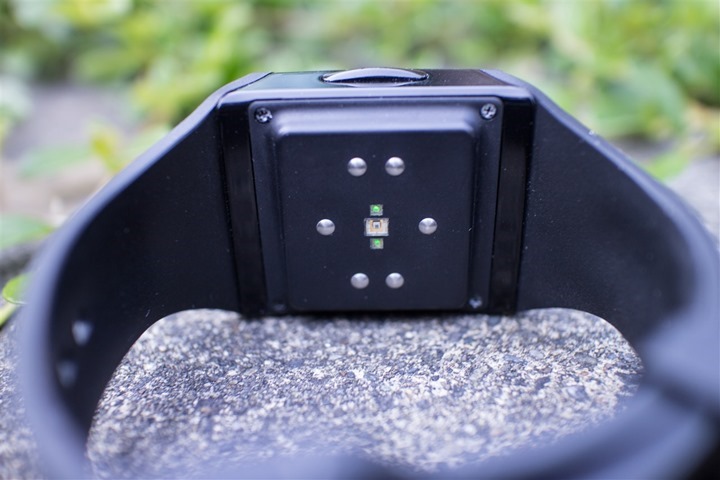
The value displayed on the screen tends to be adequately lagged, too as seemingly quite smoothed (likely to reduce the measurement imperfections). I'll get into the sports aspect in the next department. In general I find that the unit is able to determine and lock in on your center rate value far quicker than the Mio Alpha watch. And while doing day to day activities I find it within the same ballpark as a traditional heart rate strap (again, not inclusive of sports).
The key item to call back here is that because the Basis unit of measurement is doing 24×vii tracking, it'due south non super critical that it exist perfect every second of the day. At the 24×7 level y'all're really looking more than at trends. After all, equally I sit down here typing this my heart rate is showing 58 BPM, but if I become up from the table and become into the Starbucks it may be 80 BPM. At present, when I footstep back and look at the data four weeks from at present I'thou unlikely to remember what I was doing at ten:11PM on Wednesday versus 10:13PM. Thus by extension, information technology'due south more than about trending than it is well-nigh absolutes.
With that in listen, the Ground site allows y'all to expect at the middle rate data downwards to the boilerplate for whatever given minute. It can exist really interesting to start evaluating those trends. Take today for example. I've overlaid center rate against steps.
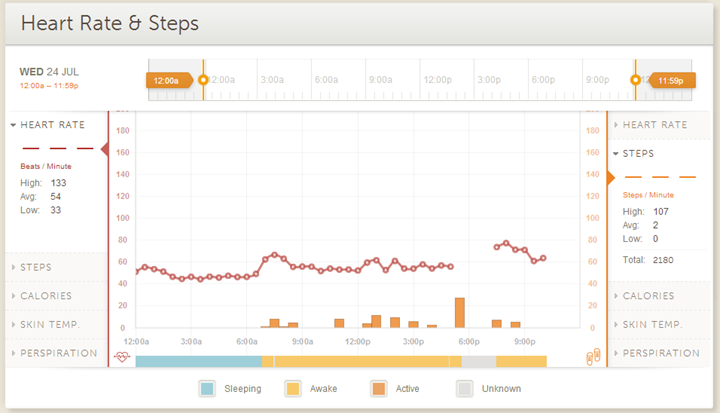
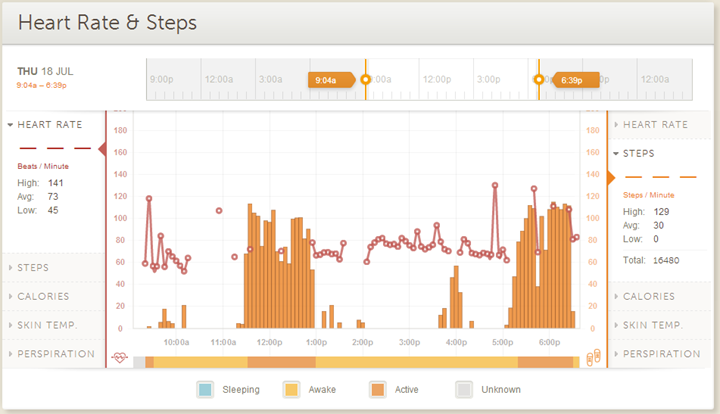
Higher up you tin can run into the course of my mean solar day. Yous can see I slept till almost 6:45AM, where while sleeping my 60 minutes was relatively low and stable. And then information technology rose as I collection into work, simply then calmed down for much of the solar day. I was in a unmarried meeting room all day doing all-twenty-four hours meetings, then there's very little action on my part today. You lot encounter a small spike around 1PM as lunch time hit and I wandered nigh for tiffin within the building. Then calm again. Then at 5:30PM I went out for a run. I didn't wear information technology while running, so you see the gap there. Post-run you run across elevated HR, only it'due south non actually considering I was tired from the run. Instead, it'southward considering I was at dinner and having lots of discussion. Finally, around 9PM y'all see it calm back down once again, as I've been typing since then.
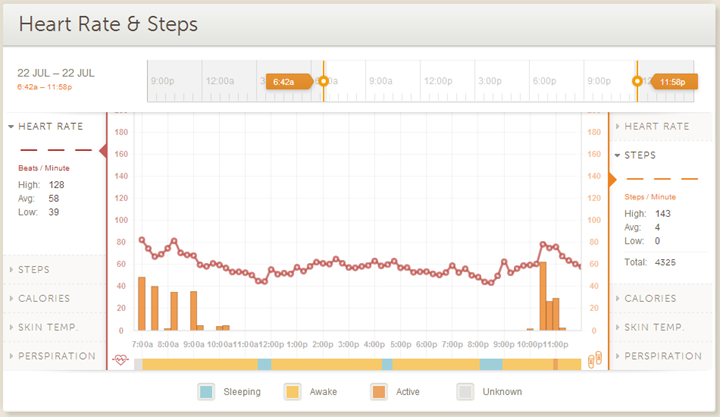
Information technology's this trending that makes the Hour attribute and then interesting. Now compare this to i week prior, the day I went and spectated the Tour de French republic at Alpe d'Huez. In this case, you can meet how the watch fails to track HR while I'm walking up the mountain. And strangely, once seems to fail tracking 60 minutes while I'm driving (x:30AM-11:30AM). You can see the random 60 minutes data points that information technology does gather here and there, but overall while I'm walking at that place's not much at that place.
Looking at another solar day, Monday, yous can see a twenty-four hour period where I flew for 12 hours. This was shown on European time, so when I landed in San Francisco I had to adjust (did that the following morn). Then what you lot come across here is my getting to the airport, then at 10:30AM boarding the aeroplane, and then basically no movement for 12 hours. In reality I got up a few times, merely otherwise those don't really show given how few steps information technology was. Yous can too see the two dips around 11:30AM and 8:30PM where I barbarous comatose briefly for about xxx-45 minutes – producing a depression ~xl BPM 60 minutes value.
Ultimately, the center charge per unit display piece is probably the nearly well done component of the watch. While the data accuracy is questionable in high-motion pieces, it'south otherwise really interesting data to look at.
For me, I use the resting HR values (which I'll talk about in the slumber section) to help me determine how rested or exhausted I am, and thus, the impact on preparation load.
Middle Charge per unit Use in Sports Activities:
The executive summary version of this section is that it simply doesn't work.
The long form version is that the Ground B1 was designed "for the other 23 hours of the day", and as such the optical center rate measurement has pregnant problems when it comes to accurately tracking heart rate at elevated levels associated with sports activities. Much of this originates from the fact that the optical heart rate sensor within the unit simply hasn't been tuned to the constant and sharp movements associated with sports activity. This is different from the Mio Alpha watch, which has been tuned for sports action, simply doesn't really work for the remainder of the day.
In many ways, I wish the two units were merged together a flake, as it'd be great for the Footing B1 to take more than flexibility in this area.
While running, you'll see that the HR data tends to either be complete garbage, or simply also laggy to be of employ.
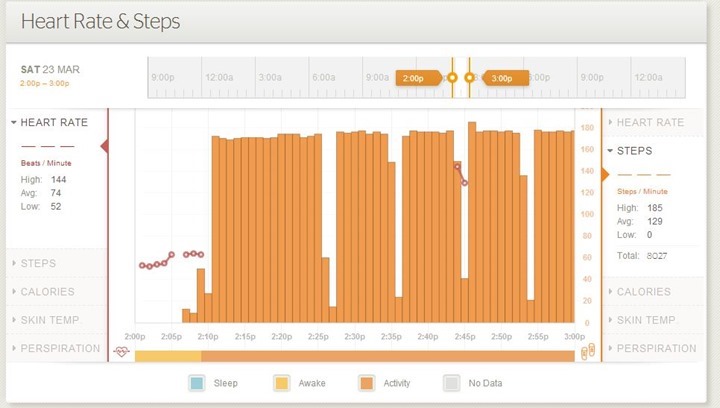
Even while cycling indoors on a trainer I'll come across cases where my actual heart rate would be 150BPM, and the Basis unit thinks it's 110BPM. I would have expected in these scenarios (sitting on a trainer), it would work better, but alas, it doesn't.
Skin Temperature & Perspiration:
While Pare Temperature and Perspiration are technically two separate metrics, I'thousand going to encompass them in a single department. If for no other reason than to make this section slightly longer. I say that because it's hard to cover a section which has and then piddling data about it. Past lilliputian, I hateful none.
The unit actually won't display skin temperature or perspiration on the brandish. Instead information technology'due south only displayed subsequently online within the Detail pages.
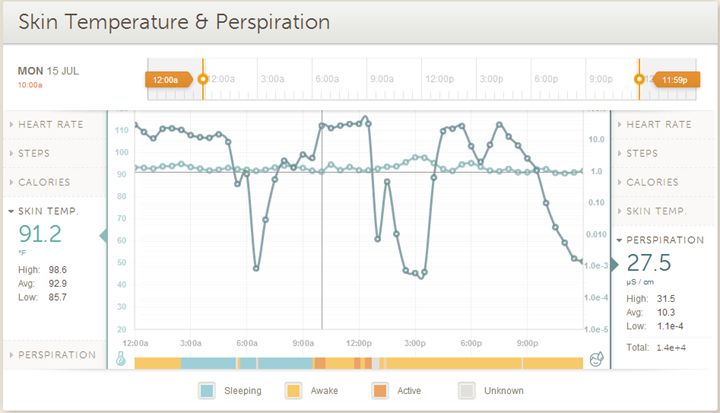
In my mind, this information is sorta similar the new Withings Scale that takes the air quality of your bathroom. There's really nothing actionable most it. I can't do anything with it equally information technology stands today and say "Oh, my peel temperature is high, allow me do XYZ".
Previously, in a white paper they released over a yr ago they talked nigh the potential of these sensors, but ultimately, that doesn't seem to have made it into the product:
"The Basis B1 band then gets data on climate, sweat level, how much motion was used to generate the perspiration, and how all of that relates to the body's internal temperature. While the raw metrics aren't seen by the user, this set of information provides a powerful set of parameters with which to model the body'southward thermoregulatory beliefs. On meridian of that, the Basis B1 band can determine the touch on the cardiovascular system via the optical processing engine—and this is something that no other device on the market today tin can practice."
Then perhaps down the road we'll see more maturity in this area, but correct now these metrics are mostly in the gee-whiz category.
Slumber:
Dissimilar most fitness trackers on the market place today, y'all don't demand to tell the Basis that you're nearly to fall asleep. Nearly other units today require that yous first let the unit know that you're about to switch to sleeping, then it tracks sleep. Only with the Basis B1, it'll automatically pickup and recognize sleep – which is pretty cool.
The reason this is meaningful is that I oft forget on other units to turn it back to 'day/activity' manner, which means that on those units it won't and then tape the steps the next 24-hour interval. Merely with the Basis information technology tracks both sleeping, as well as steps (for example, going to the bathroom in the middle of the nighttime).
Sleep isn't displayed on the lookout man itself, merely rather online after synchronization. Y'all'll commencement see information technology inside the activeness summary for the twenty-four hour period within the Insight section:
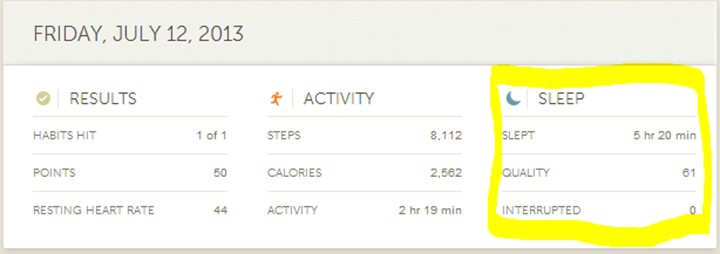
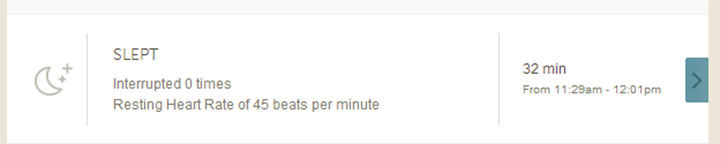
This section is actually summarizing the sleep for that 24-hour interval. You'll then run into an entry for the sleep itself, noting the exact infinitesimal you fell asleep, as well as woke up:

I plant the exact times surprisingly accurate. Including cases where I had taken a brief nap – such as waiting on takeoff on the plane, like below on a different solar day:
For the sleep totals of the day, it'll also give you a quality score. For instance, y'all'll run into below where I managed way more than sleep than normal, I got a much higher rating (95) versus before (61):
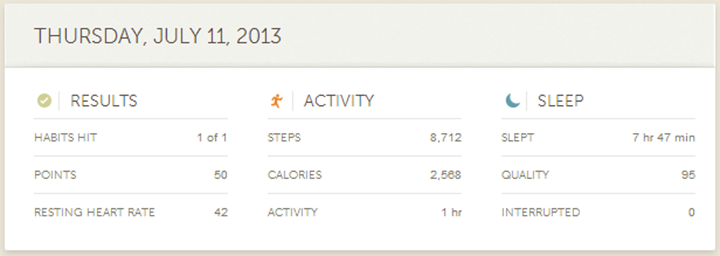
In the result of interruptions to sleep, it'll note that too.
Next to each 'activity' (including sleep) I can then dive into that activity in more detail. For instance, hither's a longer sleep session where you lot can change and wait at heart rate and other sensor metrics. You'll see my average Hour was 48 for the entire dark, but it went equally depression as 38. Along the very lesser it also labels when I was asleep, awake, active, or unknown.
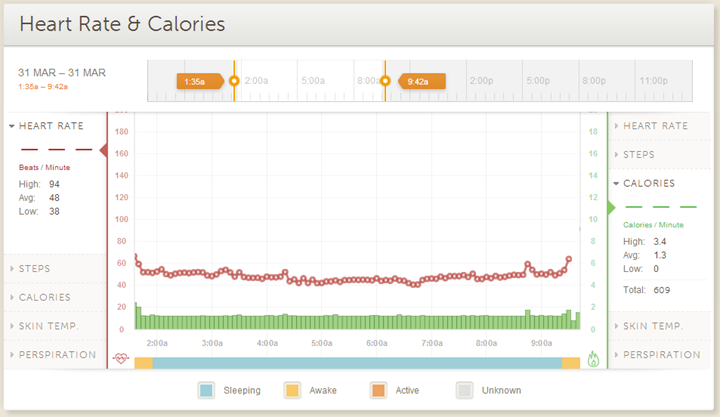
Now, it's only inside the sleep 'activities' that you'll get Resting Heart Rate data, which is then displayed in the Insights tab. Resting Middle Charge per unit (RHR) data is really useful in evaluating fatigue. While not perfect, in one case you rail resting Hr data long enough yous can very easily start to look at trends and in my training I can easily selection out when I'thousand simply exhausted. By using that I can and so explain other circumstances, such as slow paces for a given Hr.

Calories:
Finally, the Footing unit measures calories. It'll display calorie fire information on the watch itself:
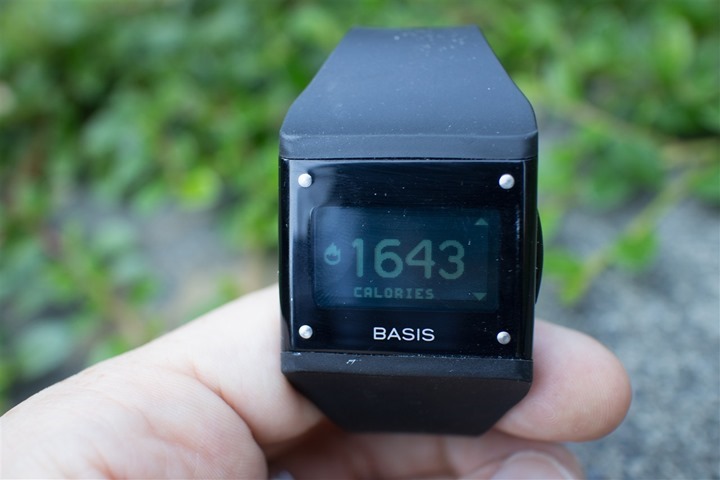
I went in search of exactly how and what information technology'south measuring, but that's pretty slim. The simply information Ground provides is this:
"The Basis band uses its diverse sensors to measure your heart rate, motion, and temperature and figures out how much energy you are using up at every moment."
Well so, glad we covered that.
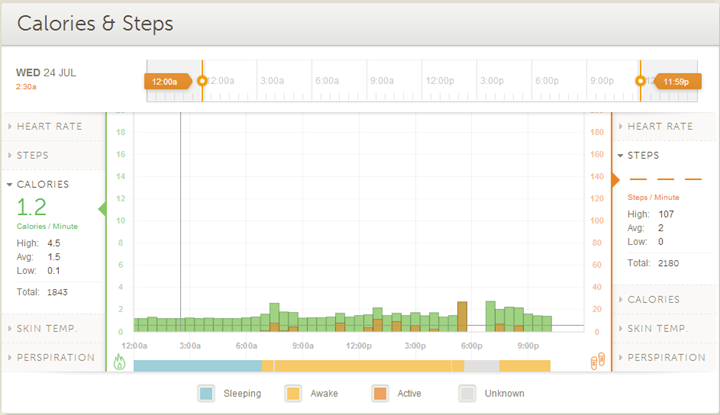
The calorie data is computed 24×vii, and does appear to include your baseline calorie expenditures. For example, if I zoom to the middle of the night, I'll see my calorie burn rate at 1.2 calories per infinitesimal. In other words, by fourth dimension I wake up in the morning I'll have burned enough calories to eat a candy bar. Or at to the lowest degree, that's my story.
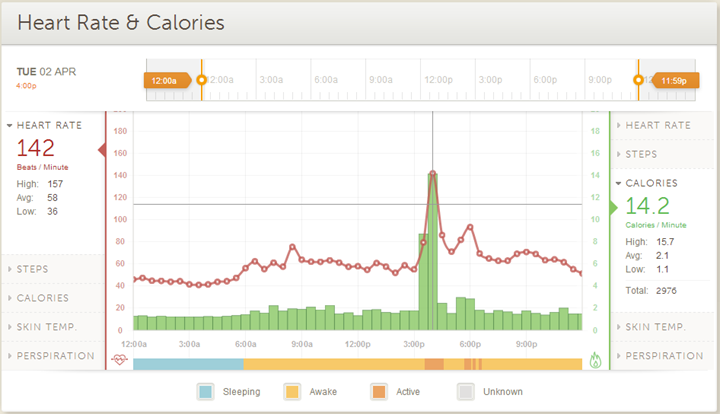
I went back and looked at a day where I had a run in the information. I was curious to run into what the calorie burn was like at that place. Surprisingly, it tracked fairly well. Assuming a calorie fire rate of xiv.2 calories per infinitesimal, that'south 852 calories/hour. Assuming a simple math gauge of 100/calories/mile, and since I'd probable boilerplate virtually 8 miles/hour, I'yard roughly in the ballpark.
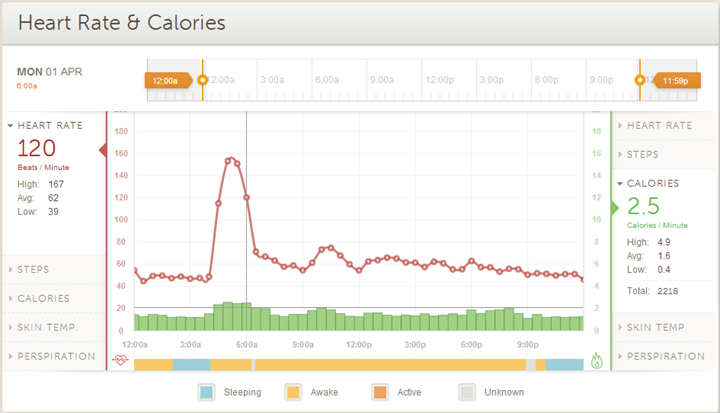
On the flip side, you lot can clearly see that the leading trigger for calorie fire isn't middle charge per unit or skin conditions, but rather steps. Have for example this indoor trainer ride. In this instance, information technology was burning at almost 2.5 calories/minute, or basically 150 calories an hour. Patently, this is way too low for a difficult hour-long trainer conditioning.
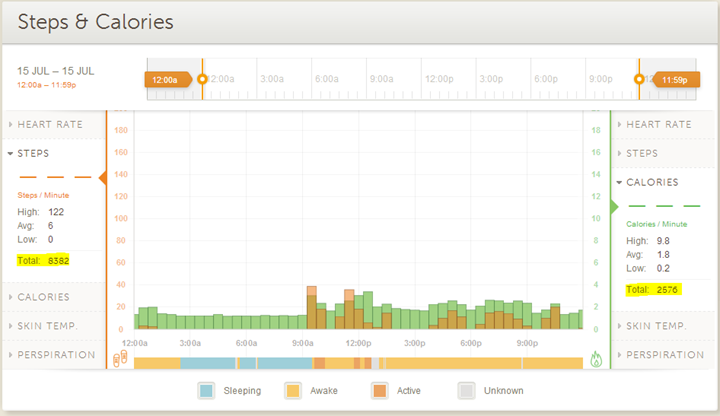
Finally, at the end of the 24-hour interval you'll encounter the totals for calorie burn down in the charts, assuasive y'all to better track how that might correlate with other activities, such as steps:
Uploading Data via Figurer:
You accept 3 options for uploading data. I'll comprehend each one separately. The starting time is via USB cable, the same USB cable that you lot use to charge your device.
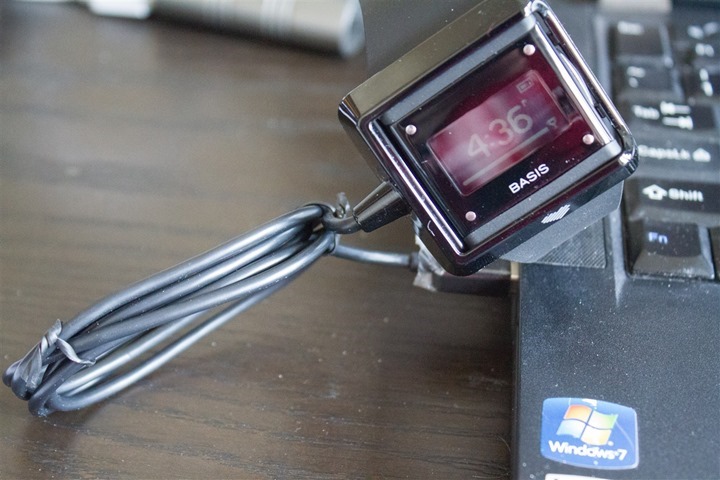
You'll merely clip in the spotter into the cable. Even afterward all these months I still find the clip portion a chip wonky. Sort of a minor puzzle each time to get information technology to popular-in. But, once it's in, you're good to charge/upload:
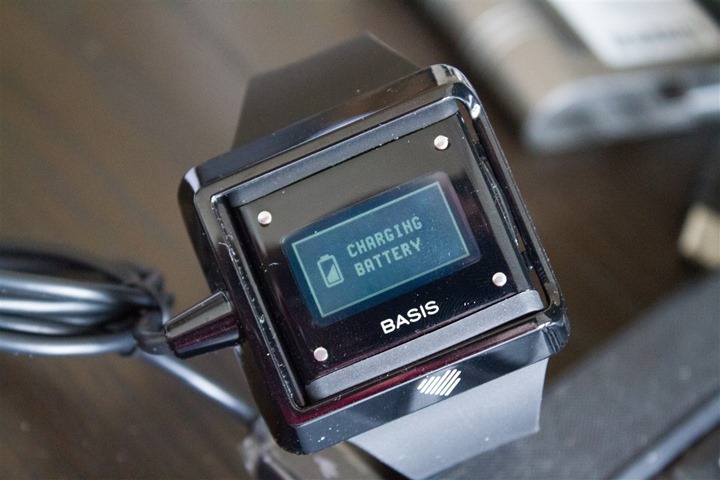
It'll trigger the desktop software – called Basis Sync – to run the synchronization process. The desktop software itself requires having authenticated with your online Footing account. I've constitute this online authentication slice more forgetful than a 90-year old grandma. The frequency at which it seems to forget my credentials and require that I re-enter them astounds me. But once I remind it, it goes about its business – the business of uploading my data.
The uploading process only takes a few seconds to complete. The Basis Sync software doesn't actually contain any settings to change, though information technology does allow you to see some basic data nearly your device:
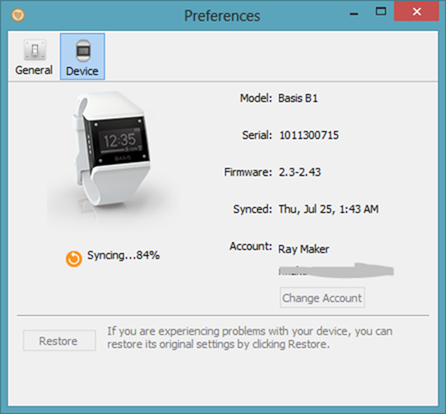
Any information that y'all demand to modify you'll need to exercise on the Basis website. I do wish they'd follow their mobile apps pb and take a setting that automatically changed the time zone of the device to your computers local time zone, rather than having to become to the site each time.
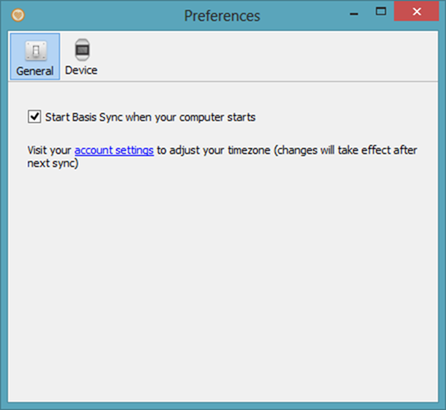
Once the data is uploaded, yous'll see information technology online every bit I've shown throughout the review to date.
iOS (iPhone/iPad) App Overview:
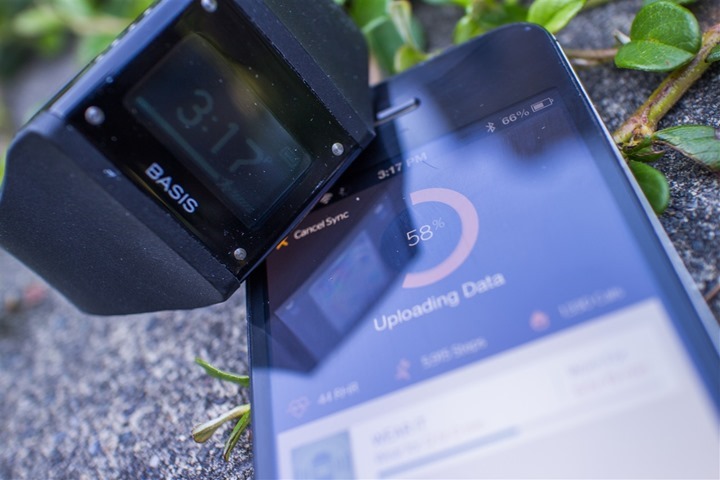
Yesterday Ground released their iOS app for the iPhone 4s and in a higher place. The app is fairly bare-bones today and actually only does 1 affair: Sync your data. Which to be fair, is all I really intendance about right at present. And for that job, it does so quite well.
To trigger the sync process you'll merely tap the right push button on your watch after opening upwardly the app on your iPhone. Then on the watch yous'll tap the push button again to sync the information:
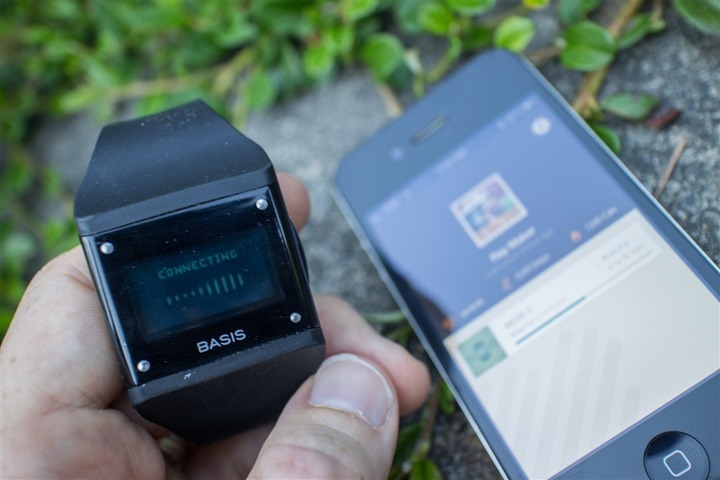
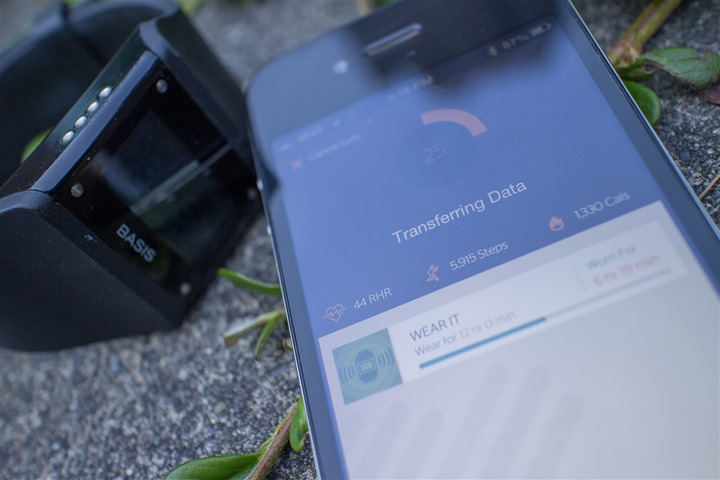
It takes perhaps 60-90 seconds to complete the process, including uploading the information:
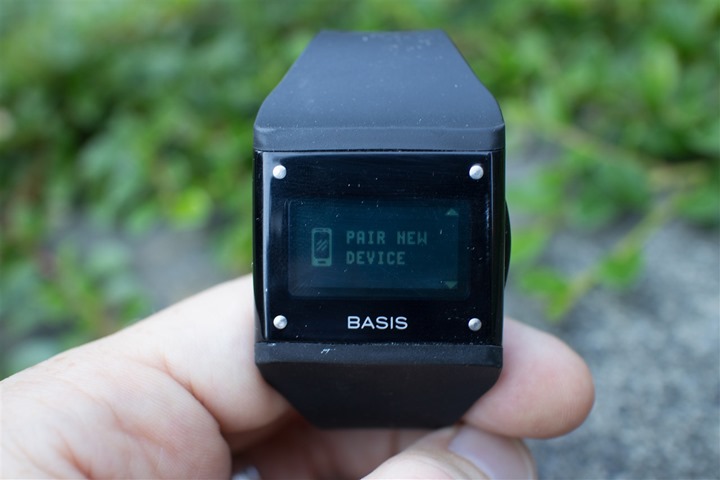
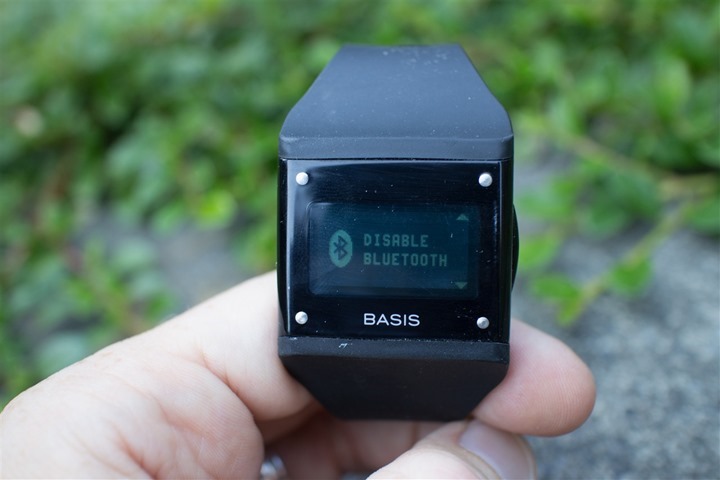
From the watch, you can also de-pair too every bit re-pair. Interestingly (and kinda cool), you can pair it to multiple devices. In my case I paired it to both an Android phone as well as a iPhone.
Finally, inside the iOS app, the only other item today offered is height-line statistics about your steps and calories, likewise every bit any habits. In that location's only not much there yet.
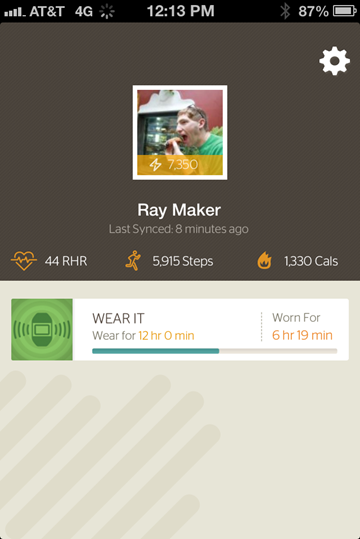
The Basis team released this ahead of their planned schedule, primarily in an effort to get the sync portion out the door, rather than waiting on everything. I'd definitely agree that was the best decision.
Android App Overview:
Until the recent release of the Basis Android app, the merely way to synchronize the data was via a physical computer connection over USB (prior to the iPhone release yesterday). The app added the ability to instead synchronize your activity data via Bluetooth– as well as change the time zone information (key for frequent fliers similar myself).
The challenge with Bluetooth,Basis, and Android though is meaning – in brusque, it's a mess. Support on different handsets is very minimal (and in fact, simply a few phones are supported for the Ground app). So you can't just apply whatever Android telephone. First, you've gotta have a phone they back up (only a few models). Then you've gotta have the right version of the Android OS. That gets fifty-fifty worse considering certain carriers restrict which OS versions you go to download.
Assuming you manage to striking all those requirements and successfully install the app – you'll be hither, set up to pair your new device.
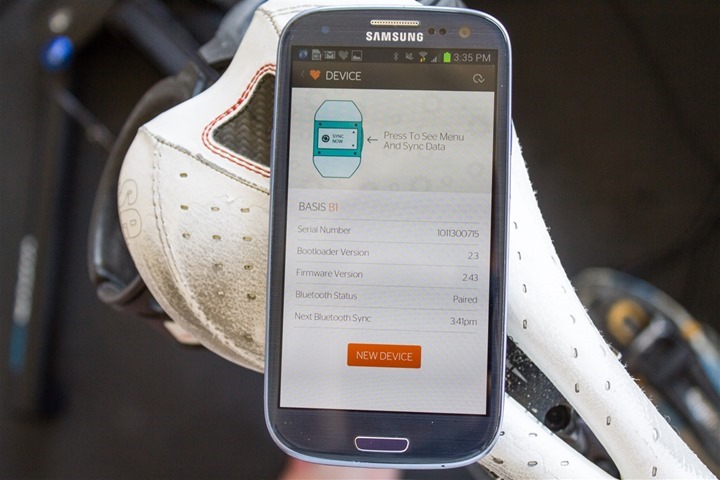
Pairing is as well offered via that same correct button, and and so pressing either up or down. The pairing procedure but takes a second, and then just like on iOS, to trigger a sync y'all'll just tap the right push:
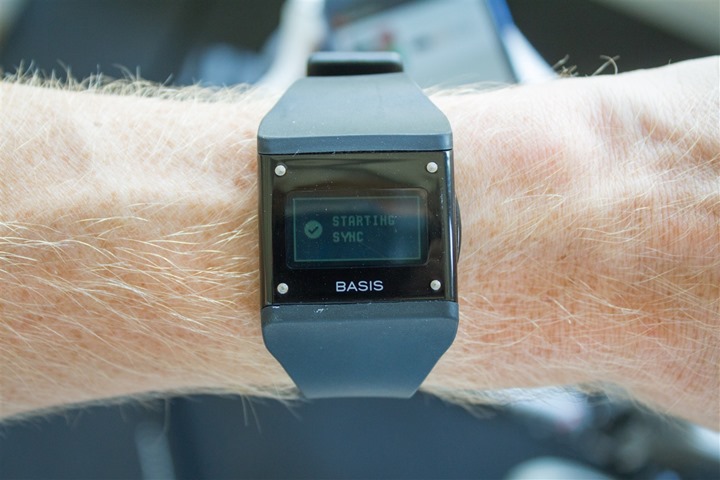
From there it'll download the data.
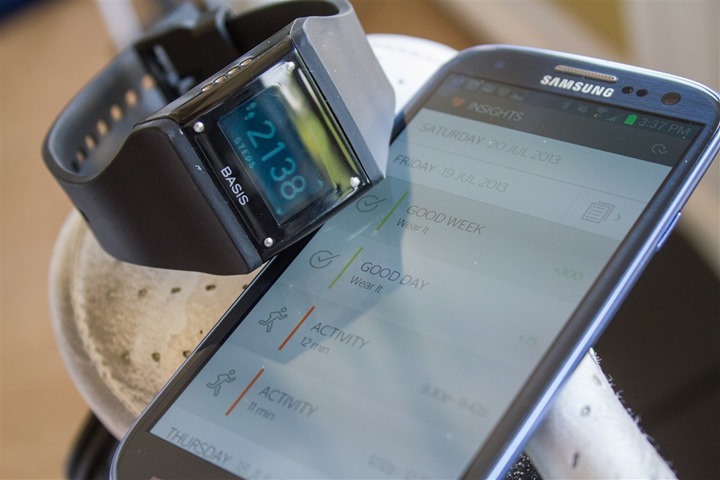
After the information is uploaded, the Android app does include a bit more than data than the iOS app. The app gives yous your Insights data, which is substantially the Facebook-feed-like timeline of your activity information:
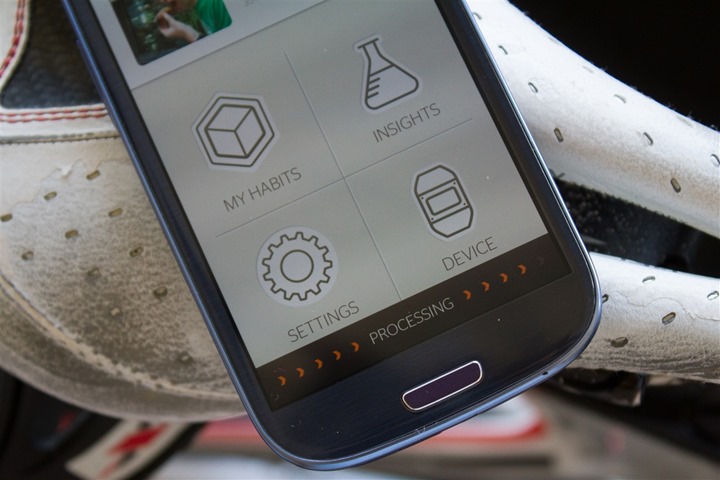
Additionally, it'll give you status on any habits:
Best of all, both the Android and iOS apps will let you automatically sync your timezone settings to your phone's fourth dimension if you travel. Ideal for people like me!
It won't notwithstanding give you detailed information admission. Ultimately, in guild to actually clarify any information, you're going to need to head up to the website.
Website Analysis:
I've covered much of the website throughout this mail, so it seems silly to re-hash it. Simply, perhaps instead to provide a most holistic context I'll only briefly talk nigh the core areas of the site and how it works. This allows you then to understand a scrap more than on where all the screenshots came from.
On the Basis site you lot've basically got three main areas you'll be looking at: Insights, Data, and Habits.
Starting with Insights, this gives you a flake of a Facebook timeline arroyo to your information. Significant events over the course of your day are bubbled up into condition chunks. For instance, sleep, segmented activities, or just general totals:
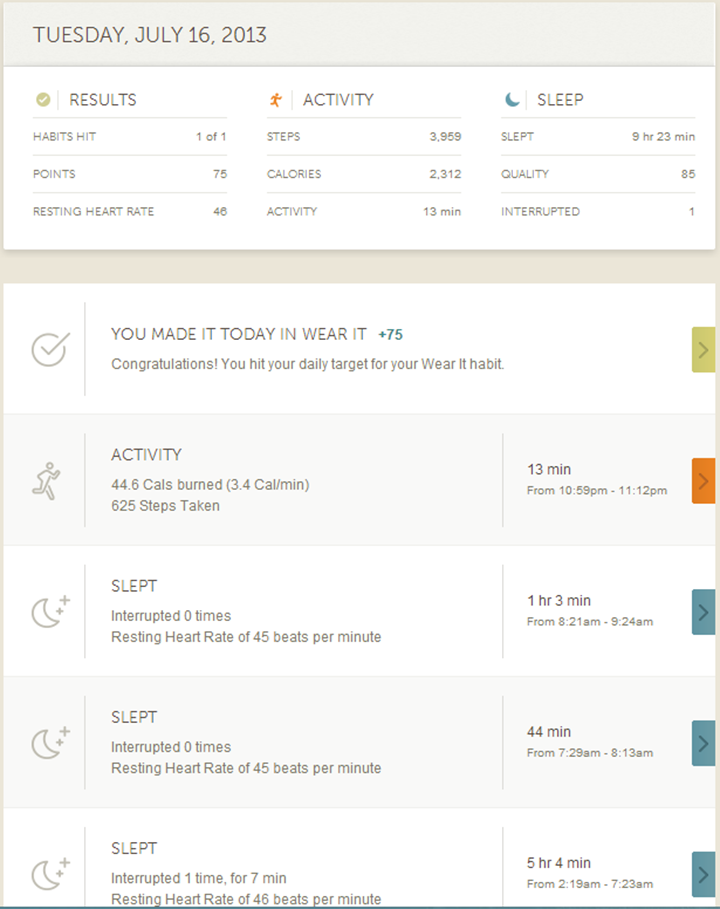
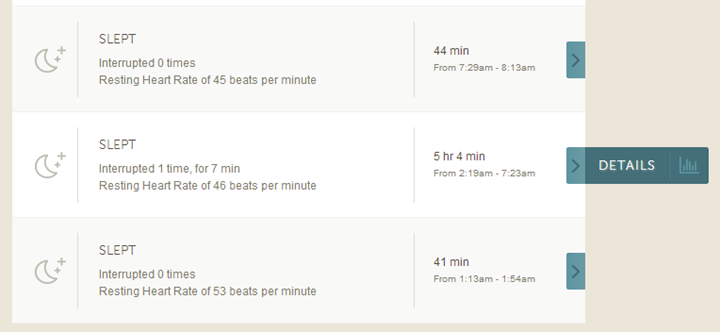
Inside that you can click on any given Insight and accept it take you to the data page with more particular on that particular moment. Sorta like double-clicking on something to expand more than detail.
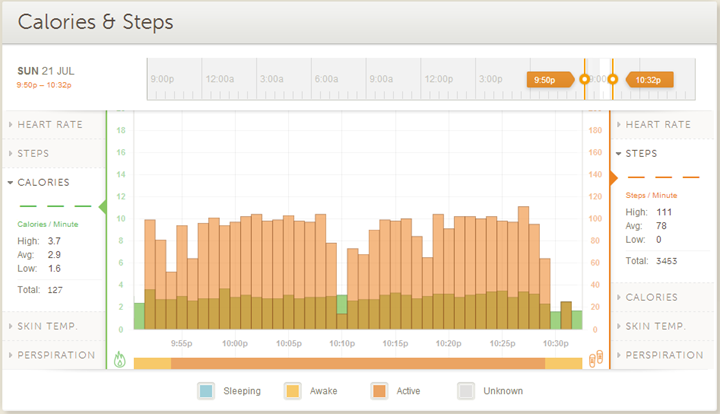
Next we accept the Information department. The Data section is divided into ii pieces, 'Detail' and 'Patterns'. Detail is what yous've seen the majority of within this review. Information technology'southward formatting is similar to HR graphs and pace metrics that you might find on a GPS watch post-conditioning, except applied to 24×vii monitoring. You can utilize the fourth dimension slider at the top to zoom in or out on a given chunk of time, and so switch which metrics are on the graph.
Meanwhile, patterns takes this up a level and provides an hourly summarized color that'southward then shown over a multi-week period. This allows you to clearly see patterns. For example, below you can easily start to identify patterns within my day to 24-hour interval schedule:
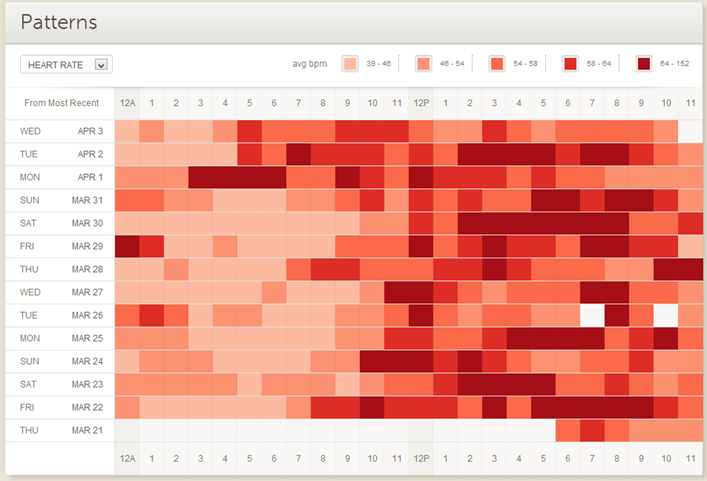
To a higher place you lot can run into my Hour patterns for a two calendar week period. You'll see my HR is lowest during the twenty-four hour period, and highest mid-24-hour interval, peculiarly in the early evening when I'd exercise. In most of these cases I was wearing information technology during runs/bikes those weeks, hence the college data points.
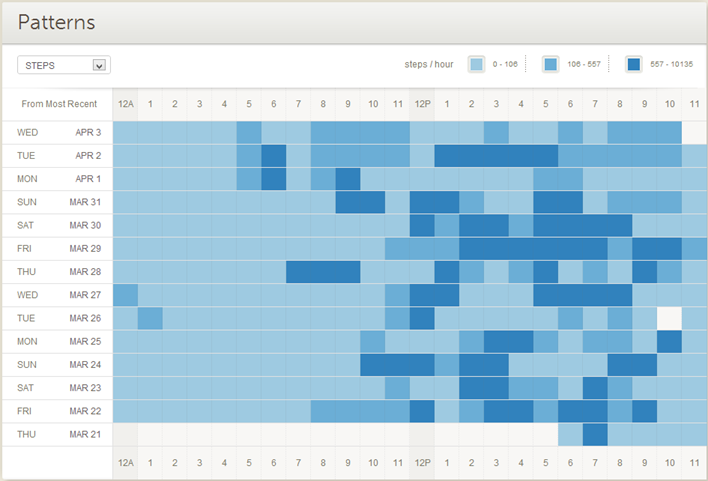
You can switch to different metrics (Calories, Heart Rate, Pare Temp, Perspiration, Steps), and run into how things bear upon one another. For example, more steps tends to equal higher Hour.
Maybe the about interesting observation is that my skin temperature is really warmest at night. I suspect though this has to do with simply being nether the blankets while sleeping, more than information technology has to practice with my actual skin temperature.
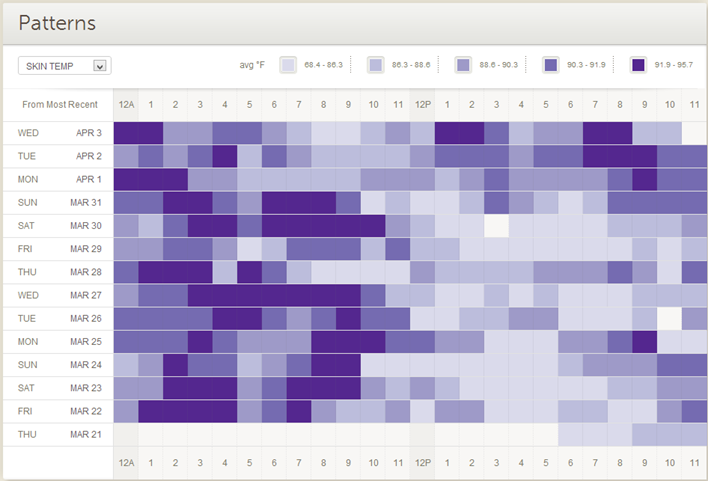
The challenge with the patterns slice and me personally is my travel schedule. The unit of measurement doesn't actually correctly utilize the time zone information, but instead merely leaves everything equally-is. This means that when I expect at it right now, everything is showing similar I slept in the eye of the day, because while I'm on the US West Declension today, I've otherwise been in Europe the previous two weeks:
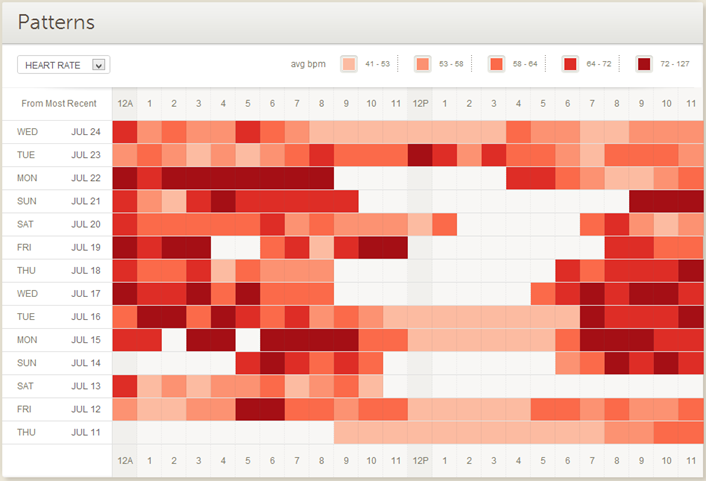
Above you'll see the gray boxes are where I wasn't wearing the unit. Sometimes I sleep with it, sometimes not.
That said, aside from time-zone wonkiness, patterns is probably the best way to start making statements most your day to day activity levels and…well..patterns.
Lastly we've got Habits. Habits is probably the area I used least, simply considering I found it least interesting. Though, I could encounter how others might discover information technology valuable. The thought behind Habits is to mensurate a repeatable task. Out of the box it includes the 'Wear It' addiction, which is designed at getting yous to wear the watch daily. Each time you wear the device, it validates that Habit for the day.
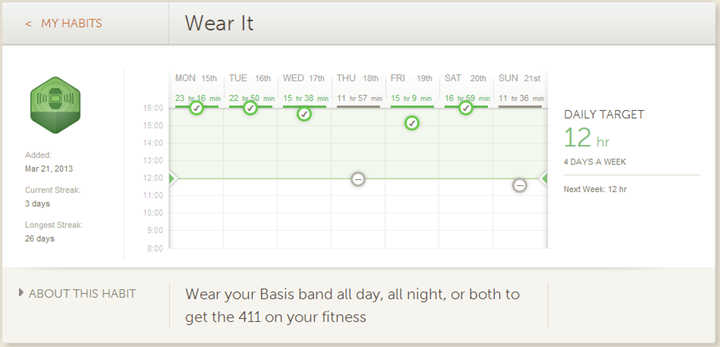
The site so allows you to create your own habits within one of 3 categories: Activity, Sleep, or 'Doing'. Except, it'due south not and so much creating your own as it is using pre-divers templates. And, in the case of 'Doing', there'due south only one (the Wear It one above). Then it's actually 'Activeness' and 'Sleep' only. And sleep only has two options. Leaving us with Activity. You tin run across that the ideas are sorta bones, basically just aimed at having you become up and move effectually.
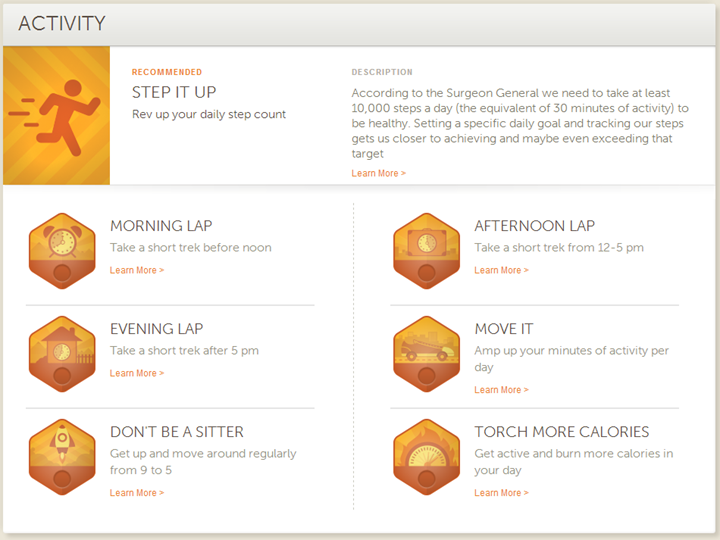
This is an expanse where I retrieve they could do a fleck more than and be more artistic in what the activities are, besides every bit expand a scrap. Information technology all seems very placeholder to me, rather than finished. Which ultimately, is why I found it fairly un-interesting.
Speaking of things that don't really seem clear, we've got the Points and Levels organisation. The platform displays points throughout the site and apps, but there'south very little information about what to do with these points. There'southward some basic data stashed abroad in a support page about how they accumulate, simply ultimately, I just don't become it. For case, is 7,550 points a good number or a bad number? What exercise I practise with these points?

Then in that location's the 'Levels'. There's admittedly zero information on the site for levels. There's this single mention of it (once again, in support), but quite bluntly, that makes no sense given the context. Given the company'south by discussions of gamification, I feel similar both Levels and Points are an attempt at checking off a checkbox on some venture capitalist scorecard that says "Practice y'all have health gamificiation?" – but beyond that, they have no value.
Updating Firmware:
The B1 supports updating the firmware to add new features or fix existing bugs. For example, in order to admission the recently added Android Sync adequacy, the firmware had to be updated.
When a new firmware update is detected, the Footing Sync software will prompt you that it needs to update the unit. It'll showtime synchronize whatsoever existing action information that hasn't yet been uploaded, then information technology'll go alee and begin the update.
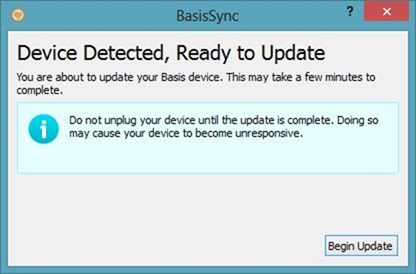
The unabridged process but takes a minute or 2 earlier it completes.
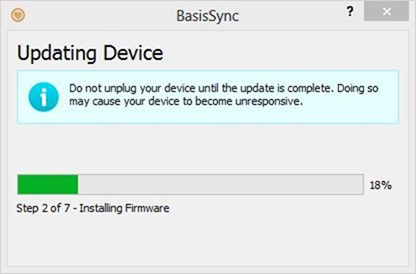
In one case the update is complete, yous'll exist back in business concern. After updating, you don't need to modify any settings on the unit itself (in part, considering there aren't whatsoever settings to modify in the unit of measurement), as the Basis Sync software will re-synchronize all of your settings back to the watch (such as time zone data).
Bombardment:
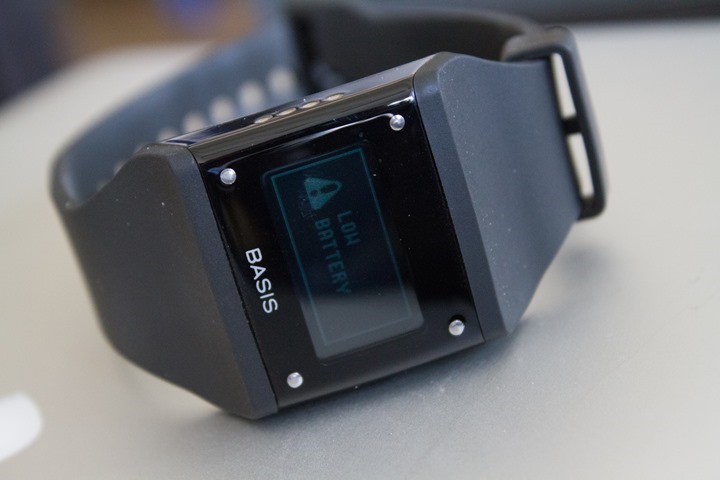
Just a super-cursory mention. I got pretty consistently 6 days of bombardment life betwixt charges. However, at present with Bluetooth enabled, I seem to be getting a scrap less in recent weeks, perhaps about 4.5 days.
The unit will brandish a depression-battery alarm when it'southward got near 4-eight hours left (it seems to vary a bit), before it goes kaput entirely.
Bugs and Miscellaneous:

In recent reviews I've been calculation a problems section to encompass things that I stumbled upon. Because I've had the lookout man for 3+ months at present, I'm really only focusing on recent bugs that I've seen. In the example of the Ground sentry, the bug I've seen are largely in the 'annoyance' category, rather than the prove-stopper category. Retrieve a 'bug' is different than 'by design'. For case, the lack of a feature is something I highlight inside a given section is considered 'by pattern', whereas something not really working right is below.
– I'd see occasional issues with the Basis Sync software forgetting credentials. While not a huge deal, information technology's been annoying.
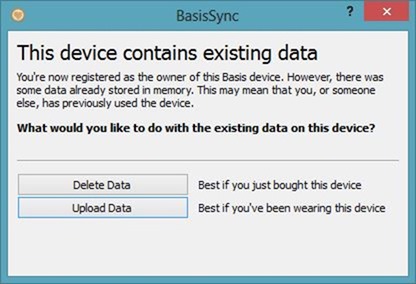
– In one case while the watch went unused a few weeks I saw an result where the watch seemed to forget who information technology was. When I plugged it into the reckoner, the software was smart enough to recognize the condition, but at the same fourth dimension I wouldn't accept expected information technology to lose simple pairing information but due to not-use for a few weeks (for example, if yous went on vacation and forgot it).
– The band itself can exist wonky. I've had information technology 'break apart', sending the watch plummeting to the ground. One time hitting concrete, another time tile kitchen floor. Neither case bankrupt the unit of measurement, and information technology's only happened 2-3 times over the last iv months, but still, ane wrong landing and it could exist done for.
– I had water issues in the commencement unit I received. This required me to have information technology swapped out from Basis. I didn't wearable it in the puddle, but did take one or two showers before it occurred (which on their site they say is fine).
Pros and Cons:
Every bit ever, the review attempts to encompass many of the more nuanced pros and cons of the device, but this cursory section boils down the large ticket items:
Pros:
– Awesome for determining day to day patterns
– Bang-up for gathering resting eye rate data
– No HR strap required
– Bluetooth Sync to both iOS and some Android phones
– Step counter tin can be reasonably accurate
Cons:
– Lookout man ring can temporarily fall apart
– Waterproofing is potentially suspect
– Heart rate data won't work while working out
– Questionable value of some data metrics (skin temperature, perspiration)
Comparison Tables:
In order to help you in comparing features, below is a comparison table of the Footing B1 unit of measurement against others fitness trackers. Note that y'all tin can both expand the nautical chart, also as create your ain comparison chart against other models that I've reviewed hither. As is always the case, I just include models in the comparison table that I've personally tested and/or reviewed.
| Role/Feature | Basis B1 | Fitbit Accuse 5 | Garmin Lily Sport | Garmin Vivosport | Fitbit Inspire 2 | |||||||||||||||||||||||||||||||||||||||||
|---|---|---|---|---|---|---|---|---|---|---|---|---|---|---|---|---|---|---|---|---|---|---|---|---|---|---|---|---|---|---|---|---|---|---|---|---|---|---|---|---|---|---|---|---|---|---|
| Copyright DC Rainmaker - Updated April 18th, 2022 @ ii:25 pm New Window | ||||||||||||||||||||||||||||||||||||||||||||||
| Price | $199 (at present discontinued) | $149 | $199 | $169 | $99 | |||||||||||||||||||||||||||||||||||||||||
| Torso Placement | Wrist | Wrist | Wrist | Wrist | Wrist | |||||||||||||||||||||||||||||||||||||||||
| Data Transfer Blazon | USB & Bluetooth 2.1 | Bluetooth Smart | Bluetooth Smart & USB | Bluetooth Smart, USB | Bluetooth Smart | |||||||||||||||||||||||||||||||||||||||||
| Bluetooth to Phone | Yep | Yes | Yes | Yeah | Yeah | |||||||||||||||||||||||||||||||||||||||||
| Has GPS congenital-in | No | Yes | No, but tin use phone GPS | Yes | No (can use phone's GPS though) | |||||||||||||||||||||||||||||||||||||||||
| Waterproofing | Shower, no swimming | 50m | 50m | 50m | 50m | |||||||||||||||||||||||||||||||||||||||||
| Battery Life | four-6 days | Up to 7 days, up to 5hrs GPS | five days | eight HOURS GPS ON | Upwardly to 5 days | |||||||||||||||||||||||||||||||||||||||||
| Bombardment Type | USB Rechargeable | USB Rechargeable | Rechargeable | Rechargeable | USB Rechargeable | |||||||||||||||||||||||||||||||||||||||||
| Child-bearing Bands/Straps | Yes | Yes | No | Yes | ||||||||||||||||||||||||||||||||||||||||||
| Phone Music Control | No | Yep | Yes | No | ||||||||||||||||||||||||||||||||||||||||||
| Watch | Basis B1 | Fitbit Accuse 5 | Garmin Lily Sport | Garmin Vivosport | Fitbit Inspire 2 | |||||||||||||||||||||||||||||||||||||||||
| Displays time | Yes | Yep | Yes | YEs | Yeah | |||||||||||||||||||||||||||||||||||||||||
| Has time alarms | No | Yes | Yeah | Aye | ||||||||||||||||||||||||||||||||||||||||||
| Has smart slumber alarms | Yes | No | No | No | ||||||||||||||||||||||||||||||||||||||||||
| Notifications | Basis B1 | Fitbit Charge 5 | Garmin Lily Sport | Garmin Vivosport | Fitbit Inspire 2 | |||||||||||||||||||||||||||||||||||||||||
| Smartphone Notifications | No | Yes | Yep | Yes | Telephone call/TEXT/Calendar/Some Apps | |||||||||||||||||||||||||||||||||||||||||
| Workouts | Ground B1 | Fitbit Charge 5 | Garmin Lily Sport | Garmin Vivosport | Fitbit Inspire 2 | |||||||||||||||||||||||||||||||||||||||||
| Workout guidance/coaching | No | Yes | No | No | Yes | |||||||||||||||||||||||||||||||||||||||||
| Data | Ground B1 | Fitbit Charge 5 | Garmin Lily Sport | Garmin Vivosport | Fitbit Inspire 2 | |||||||||||||||||||||||||||||||||||||||||
| Step Counter | Yep | Yes | Yeah | Yes | Yep | |||||||||||||||||||||||||||||||||||||||||
| Stairs Climbed | No | No | No | Yep | No | |||||||||||||||||||||||||||||||||||||||||
| Distance Walked | No | YEs | Yeah | Yes | Yeah | |||||||||||||||||||||||||||||||||||||||||
| Calories Burned | Yeah | Yeah | Yes | Aye | YEs | |||||||||||||||||||||||||||||||||||||||||
| Sleep Metrics | Yes | Yep | Yes | YEs | Yeah | |||||||||||||||||||||||||||||||||||||||||
| 24x7 60 minutes Metrics | Yep | Ys | Yes | Yes | ||||||||||||||||||||||||||||||||||||||||||
| Sensors | Basis B1 | Fitbit Charge 5 | Garmin Lily Sport | Garmin Vivosport | Fitbit Inspire two | |||||||||||||||||||||||||||||||||||||||||
| Skin Temperature | Yes | Yes | No | No | No | |||||||||||||||||||||||||||||||||||||||||
| Middle Rate | Yes | Yes | YEs | Yep | Yeah | |||||||||||||||||||||||||||||||||||||||||
| Optical Heart Charge per unit | Yes | Aye | Yes | Aye | ||||||||||||||||||||||||||||||||||||||||||
| Can re-circulate Center Rate data | No | No | No | Yep | No | |||||||||||||||||||||||||||||||||||||||||
| Pare Perspiration | Yes | No | No | No | No | |||||||||||||||||||||||||||||||||||||||||
| Cycling Sensors | No | No | No | No | No | |||||||||||||||||||||||||||||||||||||||||
| Action Camera Command | No | No | No | No | No | |||||||||||||||||||||||||||||||||||||||||
| Software | Basis B1 | Fitbit Accuse 5 | Garmin Lily Sport | Garmin Vivosport | Fitbit Inspire 2 | |||||||||||||||||||||||||||||||||||||||||
| Web Application | Yes | Yes | Garmin Connect | Yes | Aye | |||||||||||||||||||||||||||||||||||||||||
| PC Application | Yes | Yeah | Yes | Yes | Yes | |||||||||||||||||||||||||||||||||||||||||
| Mac Application | Yep | Yes | YEs | Yes | Yes | |||||||||||||||||||||||||||||||||||||||||
| Phone Apps | Android/iOS | iOS/Android | iOS/Android | iOS/Android | iOS/Android/Windows Phone | |||||||||||||||||||||||||||||||||||||||||
| Ability to export/sync settings from computer/phone | Yes | Yep | No | No | Yes | |||||||||||||||||||||||||||||||||||||||||
| Platform | Basis B1 | Fitbit Charge 5 | Garmin Lily Sport | Garmin Vivosport | Fitbit Inspire 2 | |||||||||||||||||||||||||||||||||||||||||
| tertiary parties can access information via API | No | Yes | Yes | Yes | YEs | |||||||||||||||||||||||||||||||||||||||||
| Ability to consign your data out of platform | No | Yes | Yes | Yes | Yes | |||||||||||||||||||||||||||||||||||||||||
| Purchase | Basis B1 | Fitbit Charge 5 | Garmin Lily Sport | Garmin Vivosport | Fitbit Inspire 2 | |||||||||||||||||||||||||||||||||||||||||
| Amazon | Link | Link | Link | Link | Link | |||||||||||||||||||||||||||||||||||||||||
| REI | Link | Link | ||||||||||||||||||||||||||||||||||||||||||||
| DCRainmaker | Basis B1 | Fitbit Charge 5 | Garmin Lily Sport | Garmin Vivosport | Fitbit Inspire 2 | |||||||||||||||||||||||||||||||||||||||||
| Review Link | Link | Link | Link | |||||||||||||||||||||||||||||||||||||||||||
The products are dynamically generated, and then it'due south really best to aggrandize out the nautical chart to see all results and/or customize your own.
Summary:
The fettle activity tracker segment is massive – both in potential, as well every bit how many new entrants are entering the fray each month. Companies like Nike, Fitbit, BodyMedia, and now Withings are amid the biggest – and as well most established. But all of those companies are focused on what I believe to be a slightly different consumer than that of the Basis watch. With the B1's price being about twice that of nigh of the others in the market, it has to bring more to the tabular array. And in that case, information technology does it. It brings optical heart rate recognition and 24×vii monitoring of heart charge per unit, peel temperature as well every bit movement (steps).
The question is – is that added price worth information technology? That's a fleck of a tough question. If you're looking for centre rate monitoring during sports activity, you'll be disappointed. It simply doesn't work there. Basis notes that the unit is for the other 23 hours of the mean solar day you're not working out. And I'd definitely agree with that. Don't become this unit for workout data, it's only not useful. Simply when looking at HR data for those other 23 hours, its rather illuminating in what the unit of measurement volition surface most your day to twenty-four hour period patterns.
So outside of sports, information technology by and large does the job well during that other 23 hours. Every bit you saw in my step-counter comparisons, there was definitely reliance on i arm over the other for more accurate results. I found that in twenty-four hours to day activity the optical heart rate did well (albeit slightly laggy). Only if you lot're monitoring over the grade of a day, a bit of lag is perfectly fine from macro standpoint.
Lastly, there'due south data such as skin temperature and perspiration. While these might be interesting sports science geek information points, there'due south no clarity on what to do with these metrics today from Basis. I could have labeled them "Pineapple smoothies wanted per twenty-four hours" and that would have been more than valuable to me as a consumer. And I suspect, virtually consumers will fall in the aforementioned camp.
Ultimately the Basis is a pretty fascinating first product for the company. There's a lot of really cool things, especially around 24×7 HR monitoring that work and shine really well. And then at that place's a number of areas that just need more polish and explanation. Hopefully in time that smooth volition exist applied.
With that, thank you for reading – and as always, feel free to drib a notation below and I'd be happy to effort and get questions answered as best as possible.
sawyerfornamessits.blogspot.com
Source: https://www.dcrainmaker.com/2013/07/basis-b1-review.html
0 Response to "Basis B1 Review the Best Activity Tracker Despite One Critical Flaw"
Post a Comment